The Complete Guide to Earnings Call APIs — What They Are, How They Work, and Who Uses Them
Introduction
Every quarter, thousands of public companies around the world hold earnings calls — structured presentations where executives brief investors, analysts, and the public on financial performance, strategy, and outlook. These calls are goldmines of qualitative financial intelligence.
But for developers, researchers, and fintech teams, manually accessing this data is painfully slow. That's where an earnings call API comes in.
This complete guide covers everything you need to know: what an earnings call API is, how it works under the hood, who uses it, and how to choose the right one for your product. Whether you're building an AI-powered research tool, a trading dashboard, or a portfolio analytics platform, this guide will help you get started with confidence.
What Is an Earnings Call? (The Foundation)
Before diving into the API layer, it's worth understanding what an earnings call actually is — because the value of a financial data API built around this data depends entirely on understanding what that data represents.
An earnings call is a quarterly conference call hosted by a publicly traded company's management team to discuss its most recent financial results with investors, analysts, and the general public. These calls typically follow the release of a company's quarterly or annual earnings report and give stakeholders a direct window into how the company is performing, what trends are shaping its industry, and what management expects in the periods ahead.
While regulators like the SEC require companies to file quarterly (10-Q) and annual (10-K) reports, holding an earnings call is not legally mandated. In practice, however, nearly every major publicly traded company holds one — it has become a standard expectation from Wall Street and the investment community.
Who Participates in an Earnings Call?
A typical earnings call involves two groups:
Company side: The CEO usually opens with a high-level overview of financial performance and strategic direction. The CFO follows with a deeper breakdown of specific metrics — revenue, earnings per share (EPS), profit margins, and cost structures. An Investor Relations (IR) representative typically opens the call with a legal disclaimer and manages the agenda.
Analyst and investor side: Sell-side analysts from major banks and research firms ask detailed questions during the Q&A session. Institutional investors and, increasingly, retail investors also participate or follow along via live transcripts and recordings.
What Is Discussed on an Earnings Call?
Earnings calls go well beyond the raw numbers in a financial report. Typical discussion topics include:
- Revenue growth or decline and the reasons behind it
- Earnings per share (EPS) versus analyst expectations
- Gross and operating margin trends
- Product launches, market expansion, or new strategic partnerships
- Mergers, acquisitions, or divestitures
- Forward guidance — management's outlook for the next quarter or fiscal year
- Macroeconomic conditions affecting the business
- Competitive landscape and industry trends
The Q&A section is often the most valuable part. Analysts ask pointed questions about guidance, cost pressures, competitive threats, and business strategy — and management's responses (or evasions) are closely watched for signals about the company's true health.
How Long Does an Earnings Call Last?
Most earnings calls run between 45 minutes and one hour, though this varies by company size and the number of analyst questions. The call typically divides into two roughly equal parts: the prepared remarks from management, and the live Q&A.
Why Do Earnings Calls Matter to Investors?
Earnings calls are one of the few moments each quarter where investors can hear directly from a company's leadership team in real time. The information shared frequently moves stock prices, both during and immediately after the call. Forward guidance, in particular, tends to have an outsized impact on market sentiment: a company that beats earnings but lowers guidance often sees its stock fall sharply.
For long-term investors, tracking how management communication evolves across multiple calls, tone, language consistency, and changing narratives can be just as important as the quarterly numbers themselves.
How Can You Access Earnings Calls?
There are a few common ways to access earnings calls and their transcripts:
- Company investor relations pages — most public companies post recordings and transcripts after the call
- SEC EDGAR (sec.gov) — for formal earnings-related filings
- Specialized platforms like the EarningsCall app, which provides searchable transcripts, recordings, and call calendars
- Financial data platforms — including Bloomberg, FactSet, and others that license transcript data
- Earnings call APIs — for developers who need programmatic, structured access to this data at scale
That last option, the earnings call API — is what the rest of this guide is about.
What Is an Earnings Call API?
An earnings call API (Application Programming Interface) is a programmatic interface that gives developers structured, machine-readable access to earnings call data, including transcripts, audio files, speaker information, and metadata.
Instead of scraping PDFs or manually listening to call recordings, you make a simple API request and receive clean, structured data in JSON (or sometimes XML) format, ready to plug directly into your application or data pipeline.
Think of it as a direct pipeline between your codebase and one of the richest sources of qualitative financial intelligence on the market.
What Data Does an Earnings Call API Typically Return?
Depending on the provider, a well-built financial data API for earnings calls can return:
- Full transcript text — complete word-for-word records of the call
- Speaker segmentation — who said what, mapped to names and roles (CEO, CFO, analyst)
- Prepared remarks vs. Q&A — the structured breakdown of the two key sections of every call
- Raw audio files — for building media players or speech analytics tools
- Earnings calendar data — upcoming scheduled calls
- Forward guidance extracts — key statements about future performance
- Slide decks — presentation materials shared by the company during the call
- Call metadata — date, time, fiscal quarter, company ticker, and market session (pre/during/after market)
How Does an Earnings Call API Work?
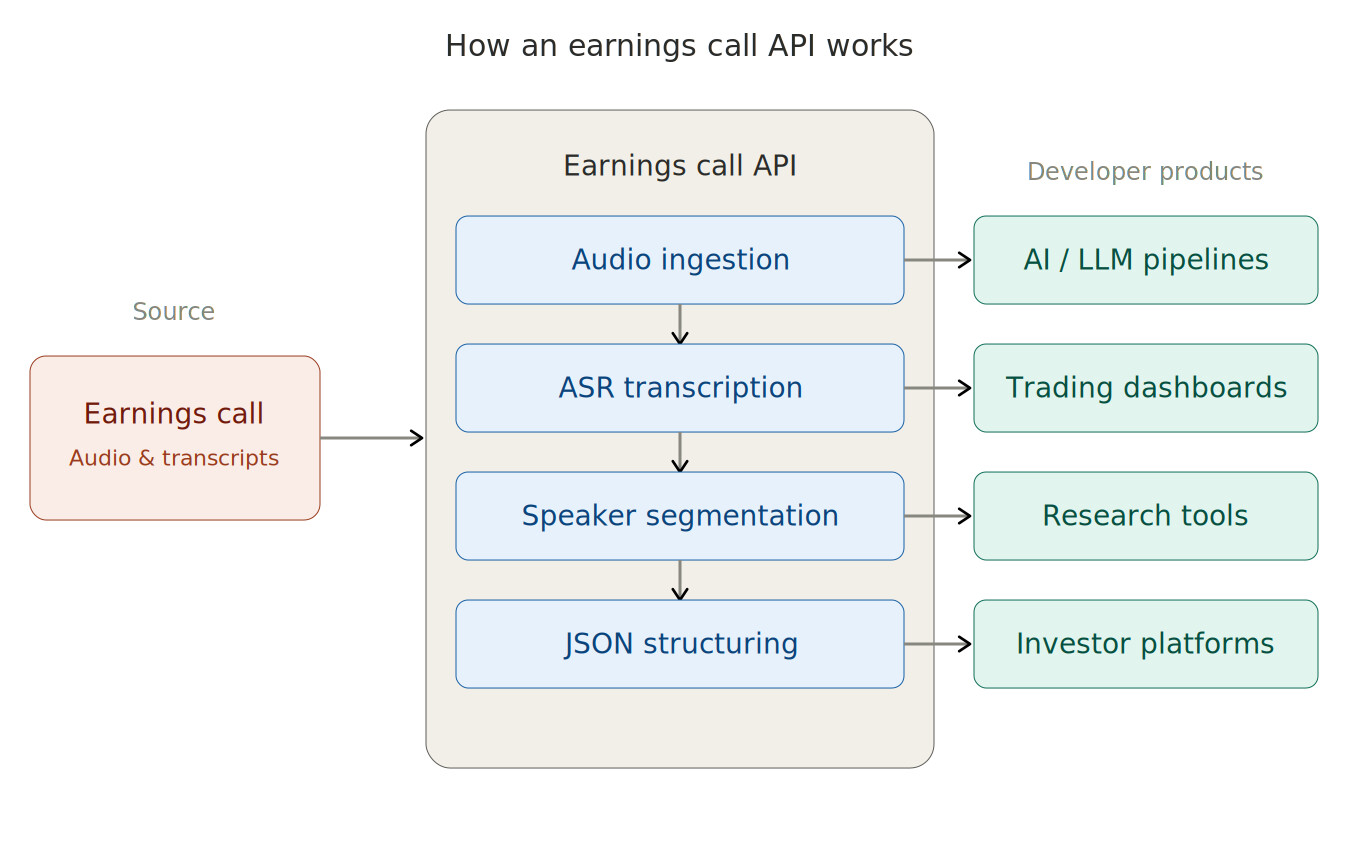
At a technical level, most earnings call APIs follow a standard RESTful architecture. Here's a simplified overview of how the data pipeline typically works:
1. Data Sourcing
Providers source earnings call content from a combination of:
- Direct company investor relations pages
- Regulatory filings via the SEC (see sec.gov/cgi-bin/browse-edgar)
- Licensed audio streams from financial data partners
- Web-scraped or ingested PDF transcripts
2. Transcription and Processing
Raw audio is converted to text using automated speech recognition (ASR) systems, often enhanced with domain-specific financial language models. High-quality providers also apply:
- Speaker diarization (identifying who is speaking)
- Role tagging (CEO, CFO, sell-side analyst, etc.)
- Section segmentation (prepared remarks vs. Q&A)
- Error correction and editorial review for accuracy
3. Structuring and Delivery
The processed data is structured into a consistent JSON schema and made available via API endpoints. Developers can query by:
- Company ticker symbol or ISIN
- Fiscal quarter and year
- Date range
- Specific call ID or event type
4. Real-Time vs. Historical Access
Most earnings call APIs offer two modes:
- Real-time delivery — transcripts and audio streamed live as the call happens
- Historical archives — databases of past calls going back years or decades
Who Uses Earnings Call APIs?
The use cases for a financial data API focused on earnings calls are wide and growing, particularly as AI and large language models (LLMs) create new demand for structured financial text data. Here are the primary user groups:
1. Fintech Developers and Startups
Developers building investment platforms, research dashboards, or financial news aggregators use earnings call APIs to power real-time content feeds, searchable transcript databases, and event-driven notification systems — without building a data collection infrastructure from scratch.
2. Quantitative Analysts and Hedge Funds
Quant teams use earnings transcript data to build signals based on language patterns, tone shifts, or forward guidance language. Sentiment extracted from CEO language has been shown to correlate with short-term price movement (see research from the National Bureau of Economic Research).
3. AI and LLM Product Teams
This is one of the fastest-growing use cases. Teams building LLM-powered financial copilots, question-answering systems, or document summarization tools need clean, structured text data — and earnings call transcripts are among the highest-signal financial documents available. An earnings call API with proper segmentation and speaker metadata dramatically reduces pre-processing overhead for RAG (retrieval-augmented generation) pipelines.
4. Retail Investor Platforms
Consumer-facing investing apps use earnings call data to surface key highlights, analyst questions, and management commentary alongside stock charts and financial metrics. Products like earnings summary cards or CEO quote feeds are powered by exactly this type of financial data API.
5. Academic Researchers
Finance academics regularly study earnings calls for research on corporate communication, information asymmetry, and market efficiency. APIs make large-scale corpus analysis feasible without manual data collection. The Journal of Finance has published multiple studies using earnings transcript datasets.
6. Journalists and Financial Analysts
Financial journalists and buy-side analysts use transcript access to quickly search for specific statements, track management messaging consistency over time, or surface quotes for reports and articles, tasks that would otherwise take hours of manual work.
Key Features to Look For in an Earnings Call API
Not all earnings APIs are created equal. When evaluating a financial data API for earnings calls, assess these factors:
| Feature | Why It Matters |
|---|---|
| Company Coverage | More companies = more use cases covered |
| Speaker Segmentation | Critical for AI pipelines and sentiment analysis |
| Prepared Remarks vs. Q&A Split | Saves significant pre-processing work |
| Audio + Transcript | Enables broader product use cases |
| Real-Time Delivery | Essential for event-driven applications |
| SDK Support | Accelerates time-to-first-call dramatically |
| Transparent Pricing | Avoids surprises and enables budget planning |
| Historical Depth | Important for backtesting and training datasets |
Earnings Call API Providers Worth Knowing in 2026
The market has matured significantly. Here's a brief overview of the key players:
- EarningsCall — The strongest choice for startups and independent developers. Offers official Python and JavaScript SDKs, speaker segmentation, prepared remarks/Q&A split, transparent pricing, and no annual lock-in. Covers 9,000+ US-listed companies.
- Quartr — The enterprise gold standard. Covers 14,500+ companies across 65 global markets. No public pricing; requires a sales conversation. Best for large institutions.
- Finnhub — A broad financial data platform with an earnings transcript feature and a generous free tier. Great for prototyping and validation.
- Financial Modeling Prep — Best for developers who need earnings call data as part of a broader financial data pipeline (income statements, ratios, SEC filings, and more).
- API Ninjas — Straightforward and simple. A single endpoint, clean JSON, and historical data going back to 2000. Good for simple transcript retrieval use cases.
How to Choose the Right Earnings Call API for Your Use Case
Use this decision framework:
You're a solo developer or early-stage startup → Choose an API with transparent pricing, SDKs, and no sales friction. EarningsCall is purpose-built for this.
You're building an AI/LLM-powered pipeline → Prioritize speaker segmentation, prepared remarks/Q&A splitting, and clean structured JSON output. These features eliminate pre-processing overhead.
You need global market coverage → Look at Quartr. Its 65-market coverage is unmatched, though expect a procurement process.
You need earnings data alongside fundamentals, filings, and ratios → A broad financial data API like Financial Modeling Prep may be more efficient than combining multiple providers.
You're prototyping and not ready to pay → Finnhub's free tier gives you enough to validate your idea before committing.
Frequently Asked Questions
Q: Are earnings call transcripts publicly available for free? Some transcripts are available through SEC filings and company investor relations pages, but they are inconsistently formatted and require significant manual effort to collect at scale. An earnings call API automates and standardizes this.
Q: Do I need a financial data API license to use transcript data commercially? Licensing terms vary by provider. Always review terms of service before using data in a commercial product.
Q: What programming languages work with earnings call APIs? Most APIs are language-agnostic (RESTful JSON). Some providers like EarningsCall offer official SDKs in Python and JavaScript for faster integration.
Q: How accurate are automated earnings call transcripts? Accuracy depends on the provider. Leading financial data APIs report accuracy rates above 95%, with additional editorial review for high-priority calls.
Conclusion
The earnings call API market has matured into a genuinely competitive space — which is good news for developers. Whether you're building an AI research tool, a trading platform, or a retail investor app, there's now a provider with the right combination of coverage, developer experience, and pricing for your needs.
For most developers and startups in 2026, the combination of structured transcript data, speaker segmentation, and SDK support makes a specialist earnings call API far more valuable than trying to build your own data pipeline from scratch. Start with a provider that matches your scale and build from there.