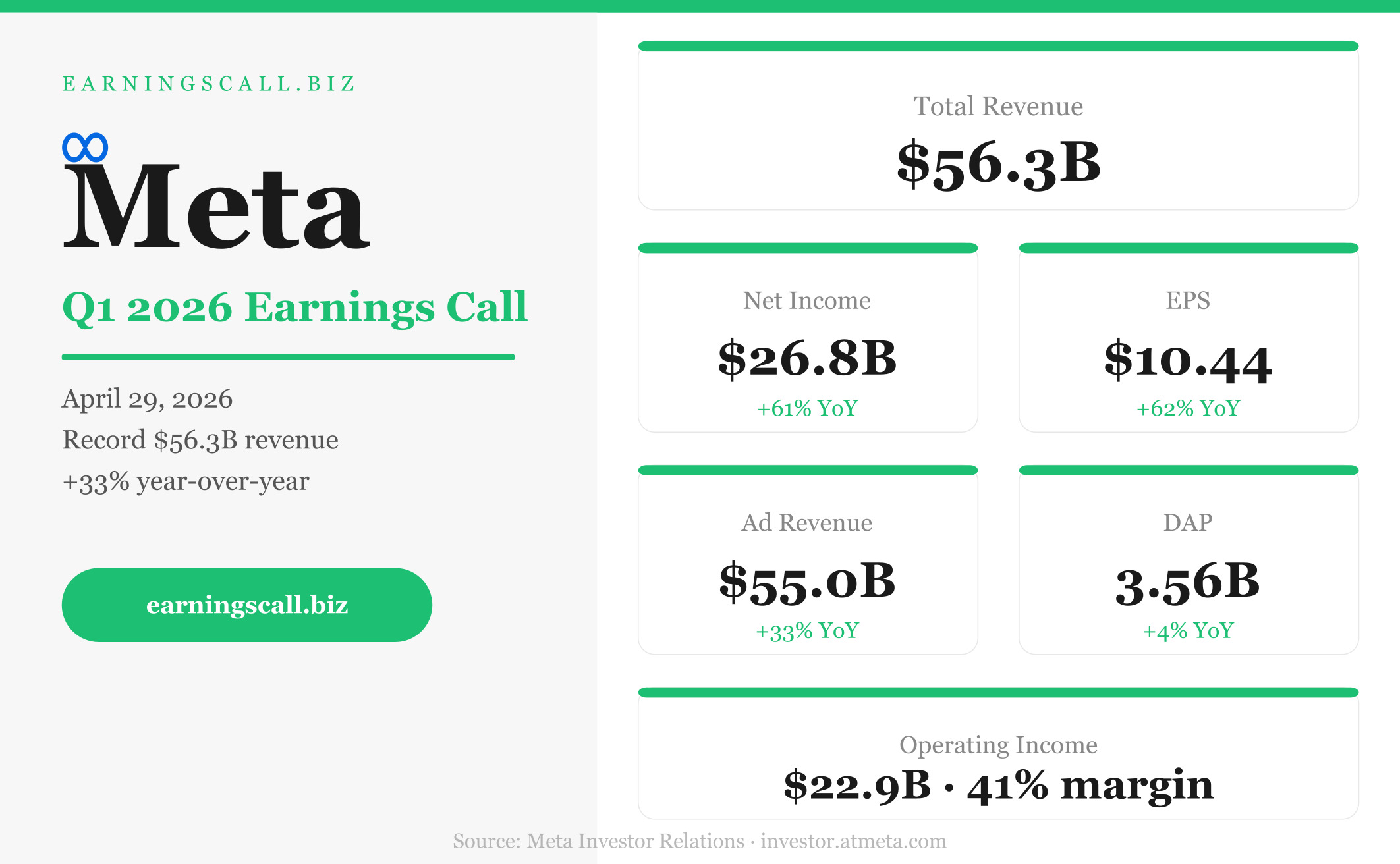
Meta Q1 2026 Earnings Call: Record $56.3 Billion Revenue
Published: May 2026 | Ticker: META | Quarter: Q1 FY2026 (March 31, 2026)
Meta Platforms delivered a record-breaking first quarter in 2026, posting $56.3 billion in revenue and its fastest growth since 2021. But the earnings call was far from straightforward — a historic user decline, a massive capital expenditure hike, and 8,000 job cuts made for one of the most eventful calls in Meta's history.
You can listen to the full Meta Q1 2026 earnings call audio and read the complete transcript on EarningsCall.
Meta Q1 2026 Earnings at a Glance
| Metric | Q1 2026 Result | Year-over-Year |
|---|---|---|
| Total Revenue | $56.3 billion | +33% |
| Family of Apps Revenue | $55.9 billion | +33% |
| Ad Revenue | $55.0 billion | +33% |
| Net Income | $26.8 billion | +61% |
| Diluted EPS | $10.44 | +62% |
| Operating Income | $22.9 billion | 41% margin |
| Daily Active People (DAP) | 3.56 billion | +4% YoY |
| Ad Impressions | +19% YoY | — |
| Average Price per Ad | +12% YoY | — |
| Capital Expenditures | $19.8 billion | — |
| Free Cash Flow | $12.4 billion | — |
| Cash & Marketable Securities | $81.2 billion | — |
Official Source: Read Meta's official Q1 2026 earnings press release on the Meta Investor Relations page.
Note on EPS: Meta's Q1 diluted EPS of $10.44 included an $8.03 billion one-time income tax benefit. Excluding this benefit, EPS would have been $7.31 — still well above analyst estimates of $6.79.
What Mark Zuckerberg Said on the Earnings Call
Meta CEO Mark Zuckerberg opened the call by describing Q1 as a milestone quarter, citing strong momentum across Meta's apps and the release of the first model from Meta Superintelligence Labs. He stated the company is on track to deliver personal superintelligence to billions of people.
Zuckerberg emphasized AI as the core driver behind Meta's advertising strength, noting that AI-powered ad tools have significantly improved targeting and performance across Facebook, Instagram and WhatsApp. He also highlighted the rapid growth of AI glasses, with Ray-Ban Meta daily users tripling year-over-year following the launch of the new MetaOptics model.
On the topic of Business AIs, Zuckerberg noted over 10 million weekly conversations with Meta's business AI tools — up from just 1 million at the start of the year — with recent expansion to small and medium businesses across Latin America, Indonesia and the Asia Pacific region.
Revenue — Fastest Growth Since 2021
Meta's total revenue of $56.3 billion, up 33% year-over-year, marked the company's fastest quarter of growth since 2021. Ad revenue drove nearly all of this, reaching $55.0 billion with both ad impressions (+19%) and average price per ad (+12%) growing strongly.
Family of Apps — which includes Facebook, Instagram, WhatsApp and Messenger — generated $55.9 billion in revenue with a 41% operating margin. This segment continues to be Meta's primary profit engine.
Meta Q1 2026 revenue breakdown — Total Revenue, Family of Apps and Ad Revenue vs Q1 2025
Daily Active People — A Historic Decline
One of the most notable moments from the earnings call was the disclosure that daily active people fell slightly on a quarter-over-quarter basis to 3.56 billion — the first sequential user decline in Meta's history as a combined family of apps.
CFO Susan Li attributed the decline to internet disruptions in Iran due to ongoing conflict, as well as a restriction on WhatsApp access in Russia. On a year-over-year basis, DAP still grew 4%, suggesting the decline was largely driven by geopolitical factors rather than any fundamental loss of engagement.
Reality Labs — Losses Continue
Reality Labs, Meta's hardware and metaverse division, generated $402 million in revenue — a 2% decline year-over-year — driven by lower Quest headset sales. The division posted a $4.03 billion operating loss, slightly better than the $4.21 billion loss recorded in Q1 2025.
Cumulative Reality Labs losses since Meta began reporting the segment separately now exceed $90 billion. The division has absorbed significant budget cuts throughout 2026, with its budget reduced by 30% in earlier rounds ahead of the broader 8,000-person layoff announcement.
The Big Story: CapEx Hike and 8,000 Layoffs
The single biggest talking point from the Q1 2026 earnings call was Meta's decision to raise its 2026 capital expenditure guidance from $115–135 billion to $125–145 billion. Management cited higher component pricing — particularly for Nvidia GPUs and custom chips — along with additional data center construction costs as the primary drivers.
Despite beating on both revenue and EPS, Meta's stock fell roughly 7% in after-hours trading, with investors reacting to the capex increase and the concurrent announcement that Meta would cut approximately 8,000 employees — around 10% of its workforce — while also closing 6,000 open roles.
Zuckerberg framed the layoffs as necessary to offset rising infrastructure costs and improve organisational agility, signalling that headcount efficiency will remain a priority as AI spending accelerates.
Meta raised 2026 CapEx guidance to $125–145B while announcing 8,000 job cuts — sending stock down 7%
AI Investment — The Core Thesis
AI remains the defining theme of Meta's strategy in 2026. The company signed a $27 billion infrastructure deal with Nebius, committed to building multiple generations of custom MTIA processors with Broadcom on a 2-nanometre process, and is reportedly exploring space-based solar energy to power data centres whose electricity demands exceed what terrestrial grids can reliably supply.
CFO Susan Li noted that despite the meaningful step-up in infrastructure investment, Meta expects to deliver 2026 operating income above 2025's $83.28 billion — a commitment to profitability growth that management leaned on heavily throughout the call.
Q2 2026 Guidance
| Metric | Q2 2026 Guidance |
|---|---|
| Revenue | $58–61 billion |
| Full Year Total Expenses | $162–169 billion (unchanged) |
| Full Year CapEx | $125–145 billion (raised) |
| Full Year Tax Rate | 13–16% (ex-tax benefit) |
Q2 revenue guidance of $58–61 billion implies continued strong growth and came in above analyst expectations of $59.6 billion at the midpoint.
Listen to the Full Meta Q1 2026 Earnings Call on EarningsCall
Want to hear exactly what Mark Zuckerberg and CFO Susan Li said — word for word? You can access the full audio and transcript of Meta's Q1 2026 earnings call on EarningsCall:
Listen to Meta Q1 2026 Earnings Call on EarningsCall
EarningsCall gives you instant access to earnings call audio and transcripts for thousands of public companies — all in one place.
Key Takeaways
- Meta posted record Q1 revenue of $56.3 billion, up 33% year-over-year — its fastest growth since 2021
- Net income rose 61% to $26.8 billion, boosted by an $8.03 billion one-time tax benefit
- Daily active people fell sequentially for the first time in Meta's history due to Iran and Russia disruptions
- Reality Labs posted a $4.03 billion operating loss with cumulative losses now exceeding $90 billion
- Meta raised 2026 capex guidance to $125–145 billion, driving a 7% after-hours stock decline
- 8,000 employees — around 10% of the workforce — will be cut to offset rising infrastructure costs
- Q2 2026 revenue guided at $58–61 billion, above analyst expectations
- AI glasses daily usage tripled year-over-year; Business AI weekly conversations grew 10x since January
Want to stay on top of every earnings call? Sign up for EarningsCall and get instant access to transcripts and audio for Meta and thousands of other public companies.