Earnings Call API vs Building Your Own Scraper
Every developer who needs earnings call data faces the same question early in the project: use an earnings call API or build a scraper that collects the data directly from investor relations pages. The scraper route feels cheaper at first glance. No subscription, no dependency on a third-party vendor, full control. The API route feels like the faster path to a working product.
Both instincts are partially right. This guide walks through what building an earnings call scraper actually requires, where an earnings call API wins on coverage, structure, and reliability, and how the total cost of each approach compares over a realistic project timeline.
What Building an Earnings Call Scraper Actually Involves
Building an earnings call scraper sounds straightforward in principle. Public companies publish earnings call transcripts and recordings on their investor relations pages. In theory, a scraper can visit those pages, find the transcript content, and extract it into a usable format.
In practice, the challenge is that investor relations pages are among the most inconsistent and least scraper-friendly destinations on the web. Each company uses a different layout, different HTML structure, and often a different third-party vendor for hosting their IR content. A scraper built for one company's IR page requires significant modification before it works on another company's page, and those modifications do not transfer. A coverage universe of fifty companies requires fifty scrapers, each with its own maintenance footprint.
The maintenance problem compounds over time. IR pages change layout without notice. Companies switch IR vendors. Transcripts move from one URL structure to another. A scraper that worked reliably last quarter may return empty results or parse garbage data this quarter without any visible indication that anything has changed. Silent failures are the most dangerous failure mode in a data pipeline because the downstream system keeps running on stale or missing data.
Research published through the National Bureau of Economic Research has documented that earnings call language carries material forward-looking information that investors and developers rely on for time-sensitive decisions. A scraper that fails silently during earnings season does not just inconvenience the developer — it breaks the analytical product that depends on it.
The Real Cost of Building an Earnings Call Scraper
The initial estimate for building an earnings call scraper usually focuses on development time for a first working version. That estimate consistently underestimates the actual cost because it ignores the ongoing maintenance burden that begins the moment the scraper is deployed.
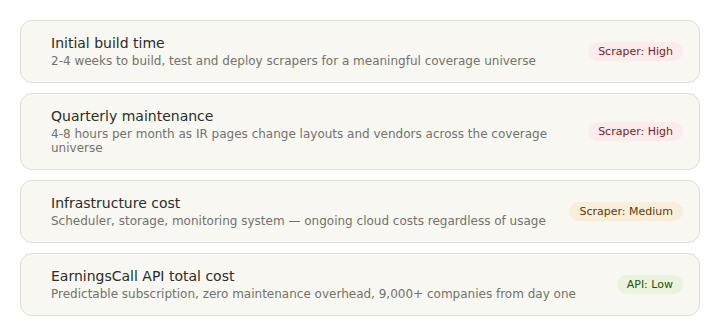
A realistic cost breakdown for a scraper covering fifty companies includes the initial build time, which for a developer working on parsing, scheduling, and storage typically runs two to four weeks. It also includes ongoing maintenance at roughly four to eight hours per month as IR pages change and scrapers break. It includes infrastructure costs for the server or cloud function that runs the scraper on schedule, the storage for raw HTML and parsed output, and the monitoring system that detects when a scraper stops returning data.
It also includes the hidden cost that most initial estimates miss entirely: speaker attribution. Earnings call transcripts are multi-speaker documents. The CFO says different things than the CEO, and the analyst questions carry different analytical weight than management responses. Raw transcript text scraped from an IR page gives you a wall of text with no speaker identification. Extracting speaker names, titles, and statement attribution from HTML that was designed for human reading, not programmatic parsing, is a significant NLP challenge that requires a separate development effort entirely.
An earnings call API at level 2 access returns speaker names and titles alongside every statement in the transcript. At level 4 access it separates prepared remarks from Q&A as distinct objects. That structure, which would take weeks to build on top of scraped raw text, is available from the first API call.
What an Earnings Call API Provides Instead
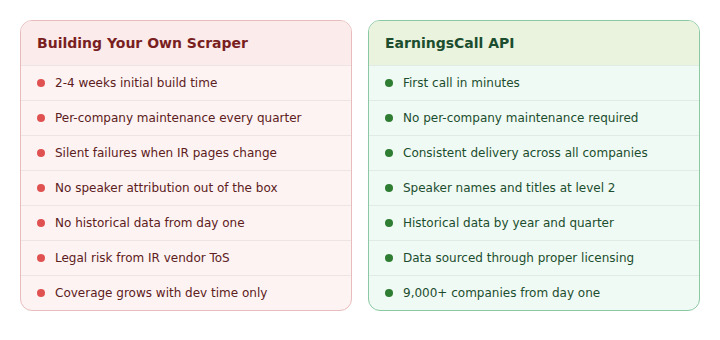
The EarningsCall API covers 9,000+ public companies through a Python SDK and JavaScript SDK. The same interface that retrieves a transcript for Apple retrieves a transcript for any other company in the coverage universe without modification. No per-company scraper maintenance, no silent failures when an IR page changes layout, no separate infrastructure to monitor and maintain.
import earningscall
from earningscall import get_company

earningscall.api_key = "YOUR-API-KEY"

company = get_company("aapl")
transcript = company.get_transcript(year=2026, quarter=1)
The transcript object returned by that call is structured JSON with speaker attribution, section separation, and consistent field names across every company and every quarter. The same code that processes an Apple transcript processes a Goldman Sachs transcript or a mid-cap healthcare company transcript without modification.
Historical data is available through the same interface. A scraper you build today only captures transcripts going forward. The EarningsCall API returns historical transcripts by year and quarter, which means a longitudinal analysis covering multiple years of data is available from the first day of integration rather than after years of scraper operation.
For developers who want to get a working integration running quickly before deciding on a longer-term data strategy, Getting Started with EarningsCall API covers authentication, first calls, and the access level structure in a single practical guide.
Where an Earnings Call API Wins on Coverage and Structure
Coverage is the most significant structural advantage of an earnings call API over building an earnings call scraper. A scraper is only as broad as the developer has time to build and maintain. A developer who builds scrapers for fifty companies has fifty maintenance obligations. Expanding to a hundred companies doubles the maintenance burden.
An earnings call API with 9,000+ company coverage means the full expansion from fifty companies to five hundred companies to the entire universe requires no additional development work. The same SDK call handles any company in the coverage universe. The calendar endpoint returns upcoming conference dates across all covered companies so the pipeline automatically detects new transcripts without manual updates to a target URL list.
from earningscall import get_calendar
from datetime import date

calendar = get_calendar(date(2026, 5, 1))
Data structure consistency is the second major advantage. Scraped transcript text is raw and unstructured. Every downstream processing step, sentiment analysis, NLP signal extraction, speaker filtering, risk monitoring, must first handle the variability in how different companies' IR pages present transcript content. An earnings call API returns consistent JSON structure across all 9,000+ companies, which means the downstream processing layer can be built once and applied uniformly.
The EarningsCall Transcripts API specifically handles the structured access to transcript content with speaker attribution and section separation. That level of structure would require a significant post-processing pipeline on top of any scraper-based approach.
Legal and Compliance Considerations
Building an earnings call scraper against investor relations pages carries legal risk that an earnings call API does not. IR pages are governed by the terms of service of the third-party vendors that host them, and many of those terms explicitly prohibit automated scraping of content. Even where terms of service do not explicitly prohibit scraping, the legal landscape around scraping financial data from investor relations pages is not settled.
An earnings call API that sources data through proper licensing agreements removes this risk entirely. The developer integrates the API and uses the data without needing to evaluate the terms of service of every IR vendor used by every company in their coverage universe.
SEC EDGAR provides official corporate filings and supplemental disclosures through a structured, publicly accessible interface specifically designed for programmatic access. For developers building compliance-sensitive applications, combining EDGAR data with an earnings call API is a defensible data sourcing approach. Combining EDGAR data with a scraper that may be violating third-party terms of service is not.
When Building a Scraper Makes Sense
To be fair, building an earnings call scraper is the right choice in a narrow set of circumstances.
If the coverage requirement is genuinely small — three to five companies that a developer knows well and can maintain personally — the overhead of a scraper may be lower than an API subscription. If the specific data required is not available through any API, such as non-standard supplemental materials published alongside transcripts on specific IR pages, a scraper may be the only option. If the project is purely exploratory and time horizon is short enough that maintenance costs have not yet accumulated, a scraper can provide a quick proof of concept.
Outside these narrow circumstances, the total cost of ownership calculation generally favours an API. Developer time is the most expensive variable in a software project, and scraper maintenance is a significant ongoing consumer of developer time that compounds as coverage expands.
FAQ
Is it legal to scrape earnings call transcripts?
It depends on the terms of service of the IR page or vendor hosting the transcript. Many third-party IR vendors prohibit automated scraping in their terms. An earnings call API that sources data through proper licensing agreements removes this legal risk entirely.
How long does it take to build a working earnings call scraper?
A first working scraper for a single company typically takes two to five days including parsing, scheduling, and basic storage. Expanding to fifty companies and adding speaker attribution, error monitoring, and historical data collection typically runs four to eight weeks of development time, not including ongoing maintenance.
What does an earnings call API provide that a scraper cannot?
An earnings call API provides structured JSON with speaker attribution and section separation from the first call, historical data across multiple years, consistent coverage across thousands of companies without per-company maintenance, and a calendar endpoint for automated transcript discovery. These capabilities require significant additional development work on top of any scraper-based approach.
How much does it cost to maintain an earnings call scraper?
Maintenance cost depends on coverage size and IR page stability, but four to eight hours per month is a realistic estimate for a fifty-company coverage universe. This cost grows with coverage and spikes each quarter when multiple IR pages change around earnings season.
Can a scraper provide historical earnings call data?
A scraper you build today only captures transcripts going forward. Historical data requires either building a one-time backfill scraper for each company in the coverage universe or using an earnings call API that stores historical data by year and quarter.
Conclusion
Building an earnings call scraper is a viable approach for small, stable coverage requirements where the developer has time to maintain it. For any coverage universe above a handful of companies, any requirement for speaker attribution and structured data, or any product where reliability during earnings season matters, the total cost of ownership favours an earnings call API.
The EarningsCall API covers 9,000+ companies through a consistent Python and JavaScript SDK, returns structured transcripts with speaker attribution and section separation, provides historical data from the first day of integration, and handles calendar-based transcript discovery automatically. The development time saved on scraper maintenance and data structuring translates directly into time available for building the analytical and product layers that create actual value.
For full API documentation and integration guides, visit the EarningsCall developer guide. For company filings and supplemental financial data, SEC EDGAR is the primary public resource.