How to Build an Automated Earnings Alert System with EarningsCall API and Claude
For fintech developers and investment teams, earnings calls are high-signal events buried inside a scheduling problem. Thousands of companies report each quarter. Knowing which ones matter, when they are happening, and what was said requires either constant manual monitoring or a system designed to do the watching automatically.
This guide shows how to build exactly that: an earnings alert API fintech pipeline that monitors upcoming calls, detects when transcripts become available, and uses Claude to generate a plain-language summary the moment a call ends. The result delivers real-time earnings alerts to any notification channel, email, Slack, or webhook, without requiring anyone to track an earnings calendar by hand.
What Earnings Alerts Actually Mean in a Fintech Context
Before writing any code, it is worth being precise about what real-time means here. EarningsCall provides post-call transcripts, structured text of what was said during a call, available after the call ends. The alert system is real-time in the notification sense: the moment a transcript becomes available, the pipeline fires and a Claude-generated summary reaches the recipient within seconds.
This is distinct from live transcript streaming during a call. What this system delivers is something more practically useful for most fintech teams: a concise, structured summary of what management said, pushed automatically as soon as the content is ready, rather than requiring someone to sit through the call or read a full transcript manually.
The system also supports a second type of real-time earnings alerts that is equally valuable: calendar-based notifications. Because EarningsCall provides upcoming conference dates through its calendar endpoint, your system can alert users days before a company they follow is scheduled to report, giving analysts time to prepare.
Why Fintech Products Need an Earnings Alert API
Manual earnings monitoring does not scale. A portfolio covering fifty companies faces two hundred earnings calls per year. A fintech product serving institutional clients may track thousands. The operational cost of staying current through manual review is prohibitive at any meaningful scale.
An earnings alert API fintech integration solves this in three ways. First, it eliminates the scheduling problem entirely: the calendar endpoint surfaces upcoming calls automatically, so no analyst has to maintain a separate watchlist. Second, it removes the reading bottleneck: when Claude summarises a transcript the moment it is available, the analyst receives the signal without touching the raw text. Third, it standardises output: every alert follows the same format, making it easier to triage a full earnings cycle quickly.
As Corporate Finance Institute's guide to earnings calls notes, the management commentary in these events often carries information that does not appear in the numerical results alone. Automating access to that commentary is increasingly a baseline expectation for competitive fintech products.
For a broader view of how developers are building financial intelligence tools on top of earnings data, Building Financial Intelligence Tools with Earnings Call Data covers the full pipeline architecture in detail.
System Architecture: Three Components
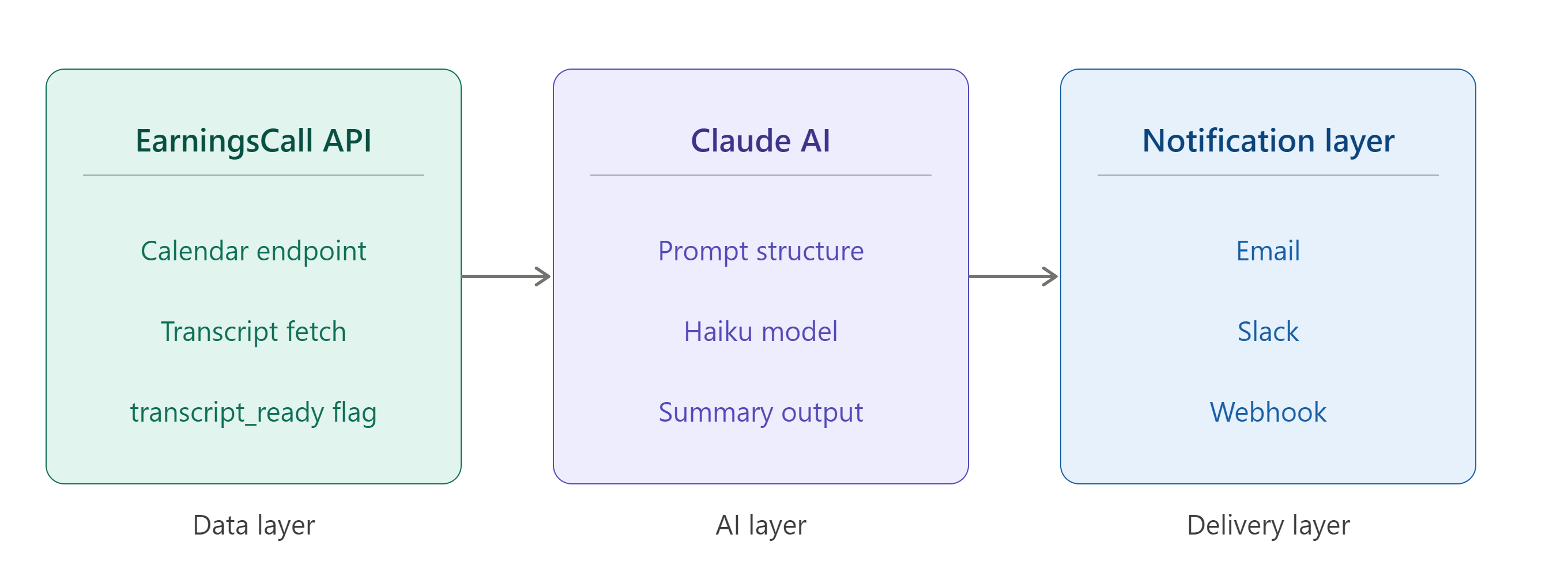
The alert system has three components that work in sequence. The first is the EarningsCall API layer, which handles calendar polling and transcript retrieval. The second is the Claude layer, which processes the transcript text and generates a structured summary. The third is the notification layer, which delivers the alert to the end user.
Each component is independently deployable. This matters in production: if the notification layer changes, the data and AI layers do not need to be rebuilt. If Claude's summarisation prompt is refined, the transcript retrieval logic is unaffected.
Step One: Calendar Polling with EarningsCall API
The calendar endpoint is the entry point for the entire system. Schedule a job to run each morning during earnings season, pulling the calendar for the next seven days and filtering for any companies in the watchlist.
import earningscall
from earningscall import get_calendar
from datetime import date, timedelta

earningscall.api_key = "YOUR-EARNINGSCALL-API-KEY"

upcoming = get_calendar(date.today())
The calendar response includes conference_date, company_name, symbol, and transcript_ready for each scheduled call. Companies with a conference_date within the alert window and transcript_ready set to false are queued for monitoring. Those where transcript_ready is already true can be processed immediately.
This is where the first type of real-time earnings alerts is generated: a heads-up notification sent to the user before the call happens, giving them context on what to watch for.
Step Two: Transcript Availability Detection
Once a company is in the monitoring queue, the system polls its transcript_ready field on a scheduled interval. When the field becomes true, the transcript fetch is triggered immediately.
from earningscall import get_company

company = get_company("aapl")
transcript = company.get_transcript(year=2026, quarter=1)
Using level 4 access, the transcript object returns prepared remarks and Q&A as separate sections, along with speaker names and titles. Passing the full text to Claude as distinct sections, rather than as a single undifferentiated block, produces more precise summaries because the model can treat scripted management commentary differently from unscripted analyst responses.
The moment this fetch completes, the pipeline hands the transcript content directly to the Claude layer. The end-to-end latency from transcript_ready firing to alert delivery is typically under thirty seconds.
Step Three: Claude Summarisation
The Claude layer takes the raw transcript text and returns a structured summary formatted for the notification. Using claude-haiku-4-5-20251001 for this step keeps latency low and cost predictable across a high volume of calls.
from anthropic import Anthropic

client = Anthropic(api_key="YOUR-ANTHROPIC-API-KEY")

prompt = f"""You are a financial analyst assistant. Summarise this earnings call transcript in four sections:
1. Key results (2-3 sentences)
2. Management tone (1-2 sentences)
3. Forward guidance highlights (2-3 sentences)
4. Analyst Q&A themes (1-2 sentences)

Prepared remarks:
{transcript.prepared_remarks}

Q&A:
{transcript.questions_and_answers}"""

response = client.messages.create(
    model="claude-haiku-4-5-20251001",
    max_tokens=512,
    messages=[{"role": "user", "content": prompt}]
)

summary = response.content[0].text
The prompt structure matters. Separating prepared remarks from Q&A in the input, and requesting structured output sections, produces summaries that are immediately usable in a notification without further processing. For investment teams, having a one-sentence tone assessment alongside the numerical highlights is often the most actionable part of the alert.
Research published through the National Bureau of Economic Research has documented that linguistic signals in earnings communications carry information beyond the numerical content alone. Claude's ability to characterise management tone consistently across thousands of calls is what makes this step more than a simple text extraction.
Step Four: Notification Delivery
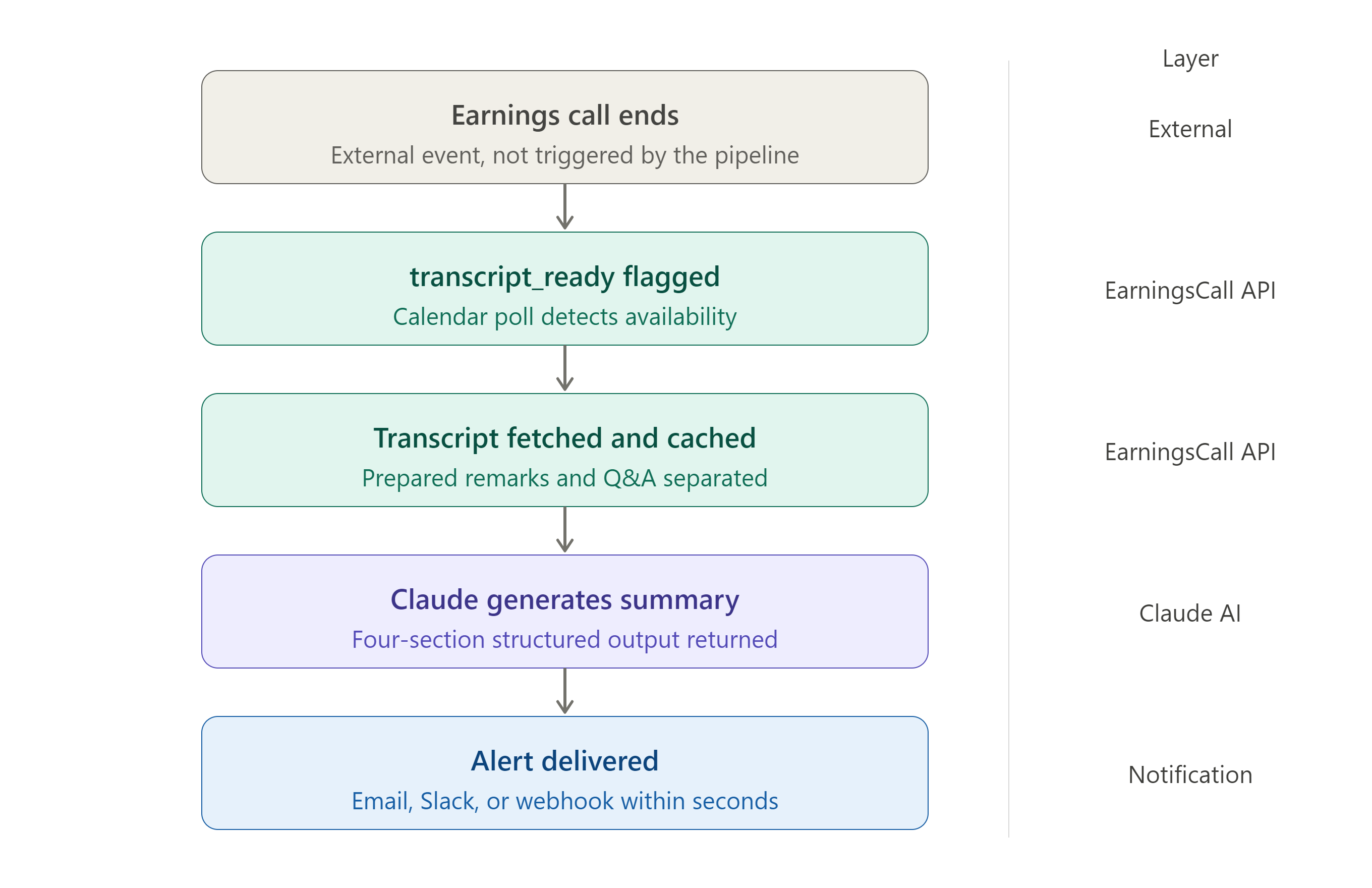
The notification layer receives the Claude summary and routes it to the appropriate channel. A basic implementation sends an email via SMTP or a Slack message via webhook. A production implementation routes based on user preferences, urgency flags, or company tier.
A well-structured alert includes the company name and ticker, the call date, the Claude-generated four-section summary, and a link to the full transcript. Keeping the alert concise is important: the goal is to let the analyst decide in ten seconds whether the call warrants deeper review, not to replace the transcript.
As Seeking Alpha's coverage of earnings analysis has noted, the most useful financial alerts are those that surface a clear signal rather than reproducing the full data. The structured prompt design in step three is what ensures the Claude output stays tight enough to be useful in a notification context.
For teams already building sentiment tooling on top of transcript data, How to Build a Hedge Fund Earnings Sentiment Dashboard shows how to extend this pipeline with NLP scoring and historical trend views.
Production Considerations
Three decisions shape how well the system holds up at scale.
The first is transcript fetch architecture. Raw transcript data should be written to a cache immediately on retrieval, with the Claude processing step reading from the cache rather than the live API. This decouples the two steps and allows the Claude prompt to be updated and re-run without re-fetching.
The second is rate handling. EarningsCall enforces a ten-calls-per-minute rate limit. During peak reporting weeks, when dozens of transcripts may become available in a short window, the ingestion layer should use the SDK's built-in retry configuration with exponential backoff to prevent queue failures.
The third is prompt versioning. Claude summaries should be tied to a prompt version in the database alongside the transcript data. When the prompt is updated, historical summaries can be regenerated, and the team can evaluate whether the new version produces better output before switching it in production.
The Journal of Finance and related academic literature on earnings communication suggest that consistency in how signals are extracted matters as much as the extraction method itself. Prompt versioning is the mechanism that enforces that consistency over time.
FAQ
What is an earnings alert API for fintech applications?
An earnings alert API for fintech applications is an integration that monitors a set of companies for upcoming earnings events and transcript availability, then triggers automated notifications when those events occur. EarningsCall provides the data layer, covering calendar events and transcripts for 9,000+ public companies, which the fintech application consumes to power its alert logic.
Are the earnings call alerts truly real-time?
The alerts are real-time in the notification sense: the system detects when a transcript becomes available and delivers a Claude-generated summary within seconds of that event. EarningsCall provides post-call transcripts rather than live-streamed content, so the alert fires after the call ends rather than during it.
Why use Claude for earnings call summarisation?
Claude processes the full transcript text, including the structured separation between prepared remarks and Q&A, and returns a concise, consistently formatted summary. This removes the need for analysts to read every transcript manually and ensures that every alert follows the same structure regardless of call length or complexity.
How many companies can the alert system monitor?
EarningsCall covers 9,000+ public companies. The alert system's capacity is determined by the polling frequency and the notification infrastructure, not by the data provider's coverage.
What programming languages does EarningsCall support?
EarningsCall provides a Python SDK and a JavaScript SDK with TypeScript support. Claude is accessible via the Anthropic API with official SDKs in Python, TypeScript, and several other languages, making it straightforward to build the full pipeline in either language.
Conclusion
An earnings alert API fintech integration built on EarningsCall and Claude replaces a manual monitoring process with a pipeline that runs continuously, scales to any watchlist size, and delivers real-time earnings alerts in a format analysts can act on immediately. The calendar layer handles scheduling, the transcript layer handles data retrieval, Claude handles the synthesis, and the notification layer handles delivery.
Each component is independently maintainable, which means the system can be improved incrementally without rebuilding from scratch. For fintech products where earnings intelligence is a core feature, this architecture provides a reliable and extensible foundation.
For full API documentation and SDK integration guides, visit the EarningsCall developer guide. For company filings and supplemental financial data, SEC EDGAR is the primary public resource.