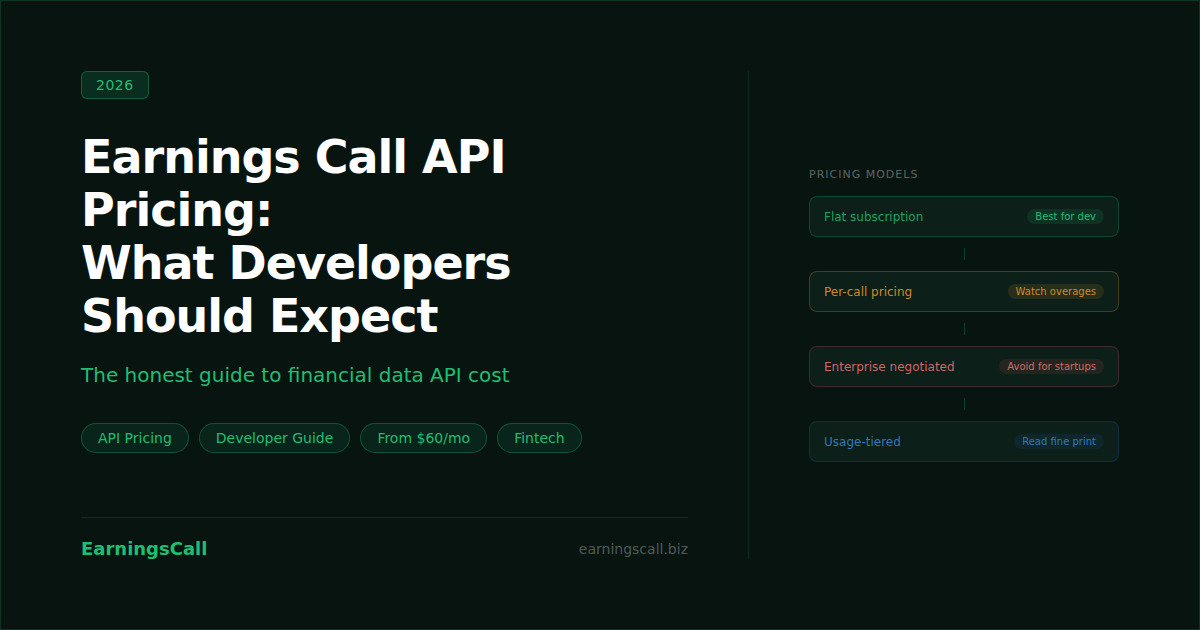
Earnings Call API Pricing: What Developers Should Expect
Financial data pricing has a reputation problem. Most institutional data vendors do not publish their prices at all. You fill out a form, wait for a sales call, and receive a quote designed around your perceived budget rather than a transparent rate card. For developers trying to evaluate earnings call API pricing before committing to a product or pitching a budget to a manager, that opacity is a genuine obstacle.
This guide breaks down how financial data API cost structures work in the earnings transcript space, what factors drive pricing, what to watch out for beyond the headline number, and how to evaluate whether a given earnings call API pricing model fits your use case.
Why Earnings Call API Pricing Is Often Opaque
The traditional financial data industry was built around institutional buyers. Bloomberg terminals, FactSet subscriptions, and enterprise data feeds were priced through sales negotiations with large asset managers, banks, and hedge funds. Pricing was never published because it was always negotiated.
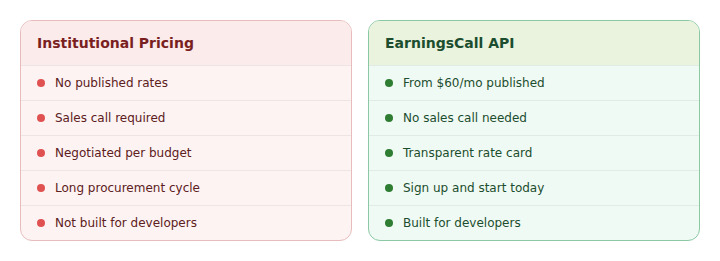
That model carried over into the earnings transcript data space even as the buyer profile shifted. Developers building fintech tools, solo quant researchers, and startup teams do not have enterprise procurement budgets or the patience for a three-week sales cycle. Yet many data providers still default to the same quote-on-request model because it is what their business was built on.
The result is that evaluating earnings call API pricing as a developer often means either getting on a sales call you did not want or guessing at cost based on fragments of public information. Neither is a good foundation for a product decision.
Research published through the National Bureau of Economic Research has documented growing demand for programmatic access to earnings call data across academic, fintech, and investment research contexts. That demand has driven a new generation of API providers to adopt more transparent pricing models aimed specifically at developer and startup use cases.
What Drives Earnings Call API Pricing
Understanding what goes into earnings call API pricing helps developers evaluate whether a given price is reasonable or inflated.
The first driver is coverage breadth. An API covering 500 companies is cheaper to maintain than one covering 9,000+. The cost of sourcing, structuring, and maintaining transcript data scales with coverage. Providers with broader coverage generally price higher, but the per-company cost tends to decrease as coverage expands.
The second driver is data structure and access levels. Raw transcript text is cheaper to provide than speaker-attributed, section-separated, structured JSON. An API that returns prepared remarks and Q&A as separate objects with speaker names and titles has invested significantly more in data processing. That investment is reflected in pricing, and it is worth paying for because the alternative is doing that structuring work yourself.
The third driver is historical depth. Real-time and current-quarter transcript access is cheaper than multi-year historical archives. If your use case requires longitudinal data, ten or more years of transcripts per company, that carries a higher cost than a monitoring tool that only needs current and recent-quarter data.
The fourth driver is update speed. How quickly does the transcript appear after the call ends? API providers that invest in fast transcript turnaround, within hours of the call ending, carry higher infrastructure costs than those where transcripts appear days later.
Common Financial Data API Cost Models
Financial data API cost is structured in several different ways across the market. Understanding each model helps you identify which fits your use case and which might look cheap upfront but cost more over time.
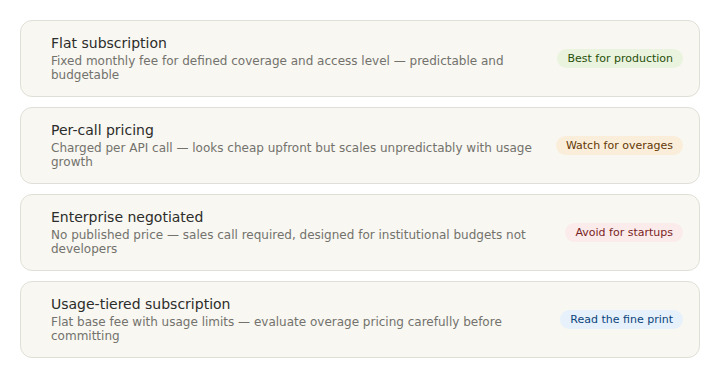
The subscription model charges a flat monthly or annual fee for a defined level of access. Coverage universe, access level, and historical depth are typically tiered across plans. This model is predictable and budgetable, which makes it the preferred choice for most developer teams building production products.
The per-call model charges based on API call volume. For exploratory or low-volume use cases this looks cheap, but the cost scales unpredictably as usage grows. A monitoring pipeline that checks transcript availability daily across a large company universe can accumulate significant per-call costs that a flat subscription would have covered more efficiently.
The enterprise negotiated model has no published price and is negotiated based on usage, company size, and perceived budget. This is the institutional model described above. For developers and startups it is almost always the wrong choice because the sales cycle is long and the pricing is rarely competitive with self-serve alternatives.
The usage-tiered subscription model combines flat monthly fees with usage limits. Base access is affordable, but exceeding coverage limits, call limits, or historical depth limits triggers overage charges. Evaluate the overage structure carefully before committing, as overage pricing can make an apparently cheap base plan expensive in production.
What EarningsCall API Pricing Looks Like
The EarningsCall API was built specifically for the developer and fintech builder use case, which is reflected in both how it is priced and how it is communicated.
Pricing starts at $60 per month, with plans structured around the coverage and access level developers actually need rather than around what an enterprise procurement budget can absorb. There is no quote-on-request gate, no sales call required to see prices, and no institutional pricing model where the same data costs an order of magnitude more because the buyer is a large fund rather than an independent developer.
The Python SDK default access on a free or demo key covers Apple and Microsoft. This means you can run the full integration, test the data structure, evaluate the transcript quality, and validate that the API fits your use case before spending a dollar. That kind of no-cost trial access is standard in developer-focused SaaS and rare in financial data specifically.
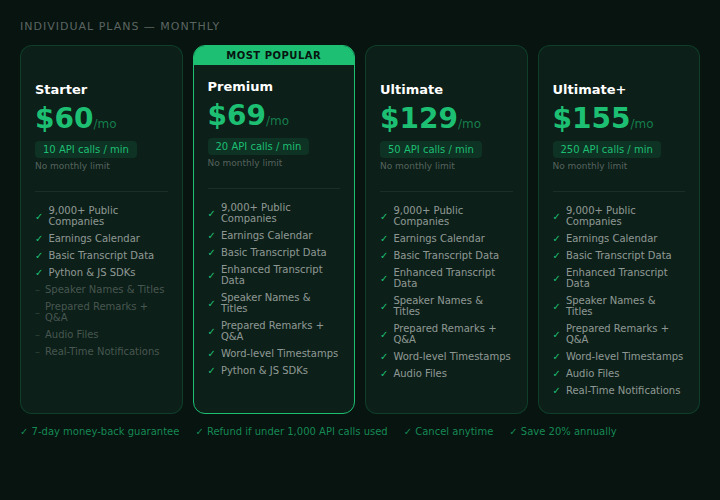
For developers who want to understand the full cost picture before evaluating pricing tiers, Getting Started with EarningsCall API covers the access level structure and what each level provides so you can match your technical requirements to the right plan before looking at pricing.
The Real Financial Data API Cost: Beyond the Subscription
Financial data API cost does not end at the subscription line item. Two additional cost categories affect the true total cost of an API data integration and are frequently underweighted in initial evaluations.
The first is developer time for data processing. An API that returns raw, unstructured transcript text requires significant downstream work to make the data useful: speaker identification, section boundary detection, sequential ordering, and format normalisation. That processing work has a developer time cost that does not appear in the API subscription price. An API that returns pre-structured data with speaker attribution and section separation at the data layer eliminates that cost entirely. When comparing earnings call API pricing across providers, the question is not just what the subscription costs but what the total engineering cost of making the data usable is.
The second is the cost of building your own alternative. Some developers evaluate API pricing against the perceived cost of scraping transcript data themselves. That comparison almost always underestimates the true cost of the scraper approach once you account for per-company maintenance, IR page layout changes, silent failure monitoring, historical data sourcing, and the legal risk of scraping third-party investor relations pages. A detailed breakdown of that comparison is covered in Earnings Call API vs Building Your Own Scraper.
The CFA Institute's research on financial data infrastructure consistently highlights that data quality and reliability have measurable downstream effects on analytical output. Choosing a cheaper but less reliable data source introduces costs that show up in analytical errors and maintenance overhead rather than in the subscription invoice.
What to Evaluate Beyond Price
Earnings call API pricing should be one input into the evaluation, not the primary one. Three other factors matter as much or more for most developer use cases.
Coverage breadth and reliability affect whether the API can serve your full use case or only part of it. An API covering 500 companies may be cheaper than one covering 9,000+, but if your product needs to handle any public company a user might ask about, the cheaper option is not actually cheaper — it is incomplete.
Data structure quality affects development time and output accuracy. Speaker-attributed, section-separated transcript data requires significantly less downstream processing than raw text. That difference translates directly into engineering hours and product quality.
Update speed and availability reliability affect whether a monitoring or alert product can deliver on its core promise. If transcripts arrive 48 hours after a call, an alert system built on that data is not genuinely useful. Evaluate the typical time from call end to transcript availability before assuming this metric is comparable across providers.
FAQ
What does an earnings call API typically cost?
Earnings call API pricing varies significantly by provider and pricing model. Developer-focused providers with transparent pricing typically start between $50 and $150 per month for production access to a meaningful coverage universe. Enterprise-oriented providers use negotiated pricing with no published rates.
Is there a free tier for earnings call API access?
EarningsCall provides demo access covering Apple and Microsoft transcripts at no cost, which is sufficient to build and test a full integration before purchasing a plan. This allows developers to validate data quality and structure before committing to a subscription.
What is the difference between subscription and per-call pricing for financial data APIs?
Subscription pricing charges a flat monthly fee for a defined level of access. Per-call pricing charges based on API call volume. Subscription models are more predictable for production pipelines. Per-call models can look cheaper for low-volume or exploratory use but scale unpredictably as usage grows.
Does earnings call API pricing include historical data?
It depends on the provider and plan tier. EarningsCall supports historical transcript retrieval by year and quarter through the same SDK interface as current-period calls. Whether historical depth is included in a base plan or requires a higher tier varies by provider.
How does earnings call API pricing compare to the cost of building your own scraper?
API subscriptions are almost always cheaper than building and maintaining your own transcript scraper when total cost of ownership is calculated correctly. The scraper approach involves initial build time, ongoing per-company maintenance, infrastructure costs, and legal risk from IR vendor terms of service — none of which appear in the initial cost estimate but all of which accumulate significantly over time.
Conclusion
Earnings call API pricing in the developer-focused segment has become significantly more transparent than the institutional data market it evolved from. Flat monthly subscriptions with published rates, free trial access, and no sales-call requirements are now the standard for providers built around developer use cases rather than enterprise procurement.
When evaluating financial data API cost, the subscription price is one input among several. Data structure quality, coverage breadth, historical depth, update speed, and total engineering cost of integration all affect the true cost of a data decision more than the headline monthly figure does.
EarningsCall starts at $60 per month, covers 9,000+ companies, provides structured transcript data with speaker attribution and section separation, and offers demo access with no payment required to validate the integration before committing to a plan.
For full pricing details and plan comparison, visit the EarningsCall API page. For company filings and supplemental financial data, SEC EDGAR is the primary public resource.