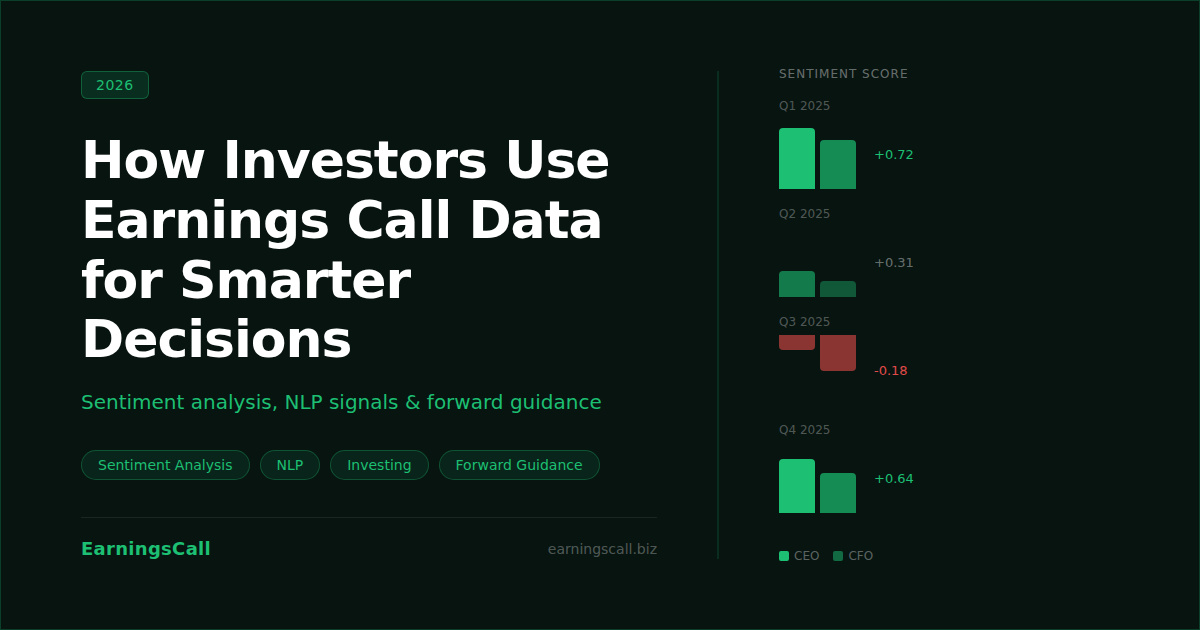
How Investors Use Earnings Call Data to Make Smarter Investment Decisions
Introduction
Every quarter, publicly traded companies open a direct line to the investment community through earnings calls. For the 45 to 60 minutes those calls run, executives speak candidly about revenue performance, competitive pressures, strategic pivots, and future expectations. The information shared in that window is among the most actionable financial intelligence available to any investor, retail or institutional.
Yet most investors only skim the headline numbers. Revenue beat or miss. EPS above or below consensus. Stock up or down after hours. The deeper intelligence sitting inside the full earnings call transcript , including the language, the tone, and the specific words management chooses to use or avoid, goes largely unexamined.
This guide explores exactly how sophisticated investors use earnings call investing strategies to build a genuine informational edge, and how earnings call sentiment analysis and tools like a financial data API are making that kind of deep analysis accessible to a much wider audience than ever before.
What Makes Earnings Call Investing Such a Powerful Strategy
Quarterly earnings reports tell you what happened. Earnings calls tell you why it happened , and more importantly, what management expects to happen next. That distinction is the entire basis of the informational advantage that experienced investors spend years learning to extract.
When Apple's CFO describes iPhone demand in China as "challenging but stabilising," that single phrase carries more investment signal than three paragraphs of financial tables. When a bank CEO avoids answering a direct question about credit quality and pivots to a talking point about operational efficiency, that evasion is itself a data point. Skilled investors read these signals the way a doctor reads body language, systematically, comparatively, and with historical context. Consider Meta's Q1 2026 earnings call, where a record $56.3 billion in revenue was accompanied by language around AI infrastructure spend that proved more significant to long-term investors than the top-line beat itself.
Earnings call investing is uniquely valuable for four reasons. First, it is forward-looking in a way that financial filings are not since management's guidance and commentary reflect their private view of what the next quarter will look like. Second, it is qualitative, adding texture to the quantitative data in the report. Third, it is comparative the same management team speaks quarterly, so shifts in language and tone are detectable over time. Fourth, it is relatively underused by the average retail investor, which means the edge from analysing it well remains real.
How Investors Analyse Earnings Call Transcripts for Investment Signals
The most systematic investors do not simply listen to or read an earnings call in isolation. They analyse earnings call transcripts against a structured framework, looking for specific categories of signal.
Management tone and language consistency is one of the most reliable indicators. Experienced investors track whether an executive's language around a topic has become more hedged, more optimistic, or more evasive compared to prior quarters. A CEO who previously described a new product line as "exciting" and now calls it "progressing as expected" has communicated a meaningful downgrade in confidence without ever using a negative word.
Beat-and-raise versus beat-and-lower dynamics matter enormously. A company that beats quarterly earnings estimates but lowers guidance for the next quarter often sees its stock fall sharply, because the market is always pricing the future, not the past. Investors who read the full earnings call transcript can understand why guidance was lowered and assess whether the reason is temporary (a one-time supply disruption) or structural (a fundamental shift in demand).
Analyst Q&A exchanges are often where the most unscripted and valuable information surfaces. When a sell-side analyst from Goldman Sachs or Morgan Stanley asks a pointed question about gross margin pressure and the CFO gives a vague, three-sentence answer before quickly moving on, that response (or lack of one) is itself a signal. Many professional investors consider the Q&A section more valuable than the prepared remarks precisely because management has less control over it.
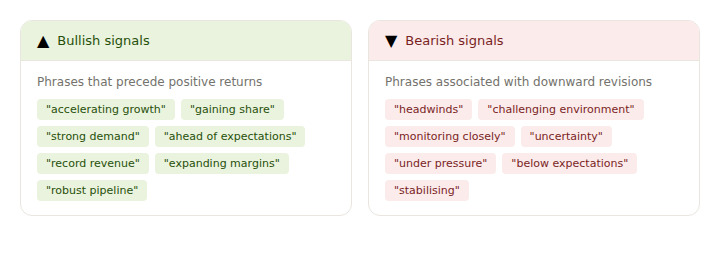
Word frequency and sentiment patterns are increasingly used by quantitative teams. Terms like "headwinds," "uncertainty," "challenged," and "monitoring closely" are statistically associated with weaker subsequent performance, while terms like "accelerating," "pipeline," "demand remains strong," and "gaining share" tend to appear in calls that precede upward earnings revisions. Researchers at the National Bureau of Economic Research have published studies showing that linguistic tone in earnings calls carries measurable predictive power for subsequent stock price movements.
Earnings Call Sentiment Analysis: Reading Between the Lines
Earnings call sentiment analysis is the practice of systematically measuring the emotional tone, confidence level, and linguistic signals in earnings call transcripts to generate investment insights. What was once a manual skill practised by veteran analysts is now increasingly automated using natural language processing (NLP) tools, and the results have attracted serious academic and institutional attention.
At its most basic level, earnings call sentiment analysis assigns a positive, negative, or neutral score to a transcript or speaker section based on the language used. A CFO who describes margin trends as "resilient," "expanding," and "ahead of expectations" scores positively. One who describes them as "under pressure," "stabilising," and "reflecting market dynamics" scores negatively, even if the actual margin numbers are the same. The difference is in the forward signal embedded in the language.
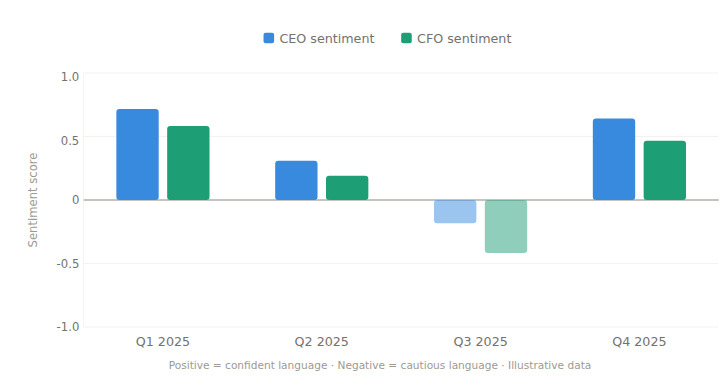
More advanced earnings call sentiment analysis goes beyond simple positive/negative scoring. It tracks how sentiment has changed across quarters for the same company, identifies when management suddenly becomes more guarded about topics they previously discussed openly, and flags statistical outliers including calls where sentiment diverges significantly from what the financial numbers would suggest. These divergences are often the most predictive signals of all.
For investors applying earnings call sentiment analysis in practice, the key is consistency. A single call's sentiment score tells you relatively little. A trend across eight or twelve quarters of transcripts from the same management team tells you a great deal covering their communication style, their tendency to over- or under-state confidence, and how reliably their language predicts subsequent financial performance.
Forward Guidance: The Most Watched Section of Every Earnings Call
If there is one section of an earnings call that moves markets more than any other, it is forward guidance , where management shares its expectations for the next quarter or fiscal year. Understanding how to interpret guidance is one of the most important skills in fundamental investing.
Guidance comes in several forms. Revenue guidance tells investors what the company expects to sell. EPS guidance tells them what it expects to earn. Margin guidance tells them how efficiently it expects to operate. Some companies provide precise numerical ranges; others give directional commentary without specific figures; a small number provide no formal guidance at all, which is itself a deliberate communication choice.
The relationship between guidance and consensus analyst estimates matters as much as the guidance itself. A company that guides for $2.10 EPS when analysts were expecting $2.25 has effectively issued a profit warning, regardless of how positively management frames it. Investors who understand this dynamic, and who access earnings call data quickly and systematically, can act on guidance updates faster than those relying on media summaries that often smooth over the details.
Guidance language is also worth parsing carefully. There is a meaningful difference between a management team that says "we expect revenue growth in the range of 8 to 10 percent" and one that says "we remain confident in our full-year targets." The first is a specific commitment; the second is a sentiment. Investors who access full earnings call transcripts through a reliable financial data API can compare the precision of guidance language across quarters and assess whether management tends to over-promise or under-promise. Apple's Q2 2026 earnings call, which revealed $111.2 billion in total revenue alongside carefully worded services guidance, is a useful illustration of how guidance language shapes investor reaction as much as the reported numbers themselves.
How a Financial Data API Makes Earnings Call Analysis Scalable
Individual investors can read one or two earnings call transcripts manually each quarter. Institutional investors covering 50 or 100 companies cannot, and neither can the fintech developers building tools to serve them. This is where a financial data API becomes essential infrastructure rather than a convenience.
A well-built earnings call API delivers structured transcript data, with speaker identification, section segmentation between prepared remarks and Q&A, raw audio files, and call metadata, directly into a developer's application or data pipeline. Instead of manually visiting investor relations pages, downloading PDFs, and reformatting text, analysts and developers get clean, consistent, machine-readable data through a single integration.
For individual investors, this means platforms and apps that surface earnings call highlights automatically, alert them when specific companies report, and let them search for keywords across hundreds of transcripts simultaneously. For institutional teams, it means the ability to run systematic text analysis, build sentiment signals, and track management language trends across an entire portfolio at scale.
Providers like EarningsCall offer exactly this kind of structured access, covering 9,000+ US-listed companies with speaker-mapped transcripts, prepared remarks versus Q&A segmentation, audio files, and slide decks, all delivered through a developer-friendly API with Python and JavaScript SDKs. For teams building investment research tools or AI-powered analysis pipelines, having this data structured and accessible through a reliable earnings call API eliminates weeks of data engineering work.
Retail vs. Institutional Investors: Different Uses of Earnings Call Data
The gap between how retail and institutional investors use earnings call data has historically been enormous, but it is narrowing fast, largely because of improved access to financial data APIs and the platforms built on top of them.
Institutional investors, hedge funds, asset managers, sell-side research desks, have long employed dedicated analysts whose entire job is to listen to earnings calls, model guidance scenarios, and produce research reports within hours of a call ending. Large institutions have also used licensed transcript databases and natural language processing tools to systematically mine language patterns across thousands of calls per quarter.
Retail investors, by contrast, have traditionally relied on news articles, earnings summaries, and the occasional CNBC clip, all of which are filtered, delayed, and stripped of the nuance that makes the original transcript valuable.
The shift happening now is that retail-facing investment platforms are increasingly building earnings call features powered by APIs, giving individual investors access to searchable transcripts, keyword alerts, and automated summaries that were previously only available to professional analysts. Platforms referencing resources like SEC EDGAR and specialised earnings data providers are closing the access gap that has historically favoured institutional players.
The playing field is not yet level, but the direction is clear. Investors who learn to use earnings call data systematically, through good tools and reliable data sources, are building a skill that compounds in value over time.
How Quantitative Analysts Use Earnings Call Sentiment Analysis and an Earnings Call API
Quantitative investment strategies have used earnings call data as a signal input for over a decade, but access was historically expensive and technically difficult. The availability of well-structured earnings call APIs has made this approach viable for a much broader range of teams.
The most common quant application is sentiment scoring, using natural language processing (NLP) to assign a positive, negative, or neutral score to each earnings call transcript or individual speaker section. These scores can then be used as inputs to a broader factor model, combined with traditional fundamental data like price-to-earnings ratios, revenue growth rates, and balance sheet metrics.
More sophisticated teams go further, building signals based on specific linguistic patterns, the use of hedging language, changes in the frequency of forward-looking statements, the ratio of CEO speaking time to CFO speaking time, or the number of times management uses the word "confident" versus "cautious." The Journal of Finance and the Journal of Financial Economics have both published peer-reviewed research demonstrating the statistical significance of earnings call language as a return predictor.
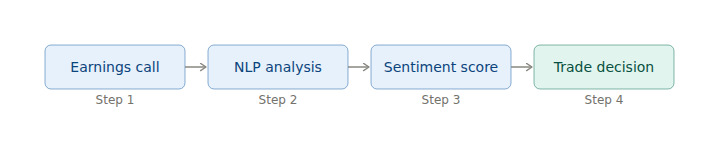
The practical workflow typically looks like this: a team pulls structured transcript data through an earnings call API, runs their NLP pipeline on the clean text, generates per-call sentiment or linguistic feature scores, feeds those scores into a portfolio construction model, and monitors signal decay over time. The entire pipeline depends on the quality and consistency of the underlying transcript data, which is why choosing the right financial data API provider is a decision that directly affects signal quality.
Common Mistakes Investors Make When Interpreting Earnings Call Data
Access to earnings call data only creates an edge if it is interpreted correctly. Several common mistakes can actually lead investors astray.
The first is focusing only on the prepared remarks and ignoring the Q&A. Management controls the prepared section, every word is rehearsed and legally reviewed. The Q&A is where unscripted, revealing responses surface. Investors who only read the first half of a transcript are missing the most information-rich section.
The second is treating guidance as a firm forecast rather than a range of management expectations shaped by incentives. Many management teams guide conservatively, knowing they will be punished far more harshly for missing guidance than rewarded for beating it. Understanding a company's historical guidance accuracy, whether they tend to over- or under-guide, requires looking at multiple quarters of earnings call data, not just the most recent one.
The third is reading calls in isolation rather than comparatively. A single earnings call transcript tells you what management said this quarter. A series of transcripts tells you how their language and confidence have evolved over time, and that trend is often more predictive than any single data point.
The fourth mistake is ignoring what was not said. Topics that received detailed discussion in prior quarters and then disappear from the agenda are sometimes the most telling signal of all. If a company spent two calls discussing the strength of its international expansion and then stops mentioning it, that silence deserves investigation.
Getting Started with Earnings Call Investing: Tools and Data Sources
Whether you are an individual investor looking to go deeper on a handful of portfolio companies, a developer building an investment research tool, or an analyst at an institution trying to scale your transcript analysis, the starting point is the same: reliable, structured access to earnings call data. If you are new to how this data is accessed programmatically, our complete guide to earnings call APIs covers how APIs work, what data they return, and how to choose the right one for your needs.
For investors who want to read transcripts manually, company investor relations pages and platforms like Investopedia and Seeking Alpha offer access to many earnings call transcripts. For teams that need programmatic access at scale, a dedicated earnings call API from a provider like EarningsCall is the most efficient path, giving you structured JSON data, speaker segmentation, audio files, and slide decks through a single integration.
The investors and teams who build a systematic process around earnings call data , rather than treating it as an occasional reference, are the ones who develop a durable edge. The data has always been available. The difference is in how deliberately and consistently you use it.
Conclusion
Earnings call investing is one of the most underutilised edges available to any investor. The data is forward-looking, qualitative, comparative, and rich with signal if you know how to read it. From retail investors building better habits around quarterly reporting season to quant teams running earnings call sentiment analysis pipelines on thousands of transcripts, the common thread is the same: systematic access to clean, structured earnings call data is the foundation everything else is built on.
As tools like the earnings call API make this data more accessible than ever before, the informational edge that earnings call investing creates is shifting from the exclusive domain of institutions toward any investor or team willing to engage with it seriously.
For more on earnings call APIs and how to access transcript data programmatically, see EarningsCall's developer guide and the SEC's EDGAR database for regulatory filings.