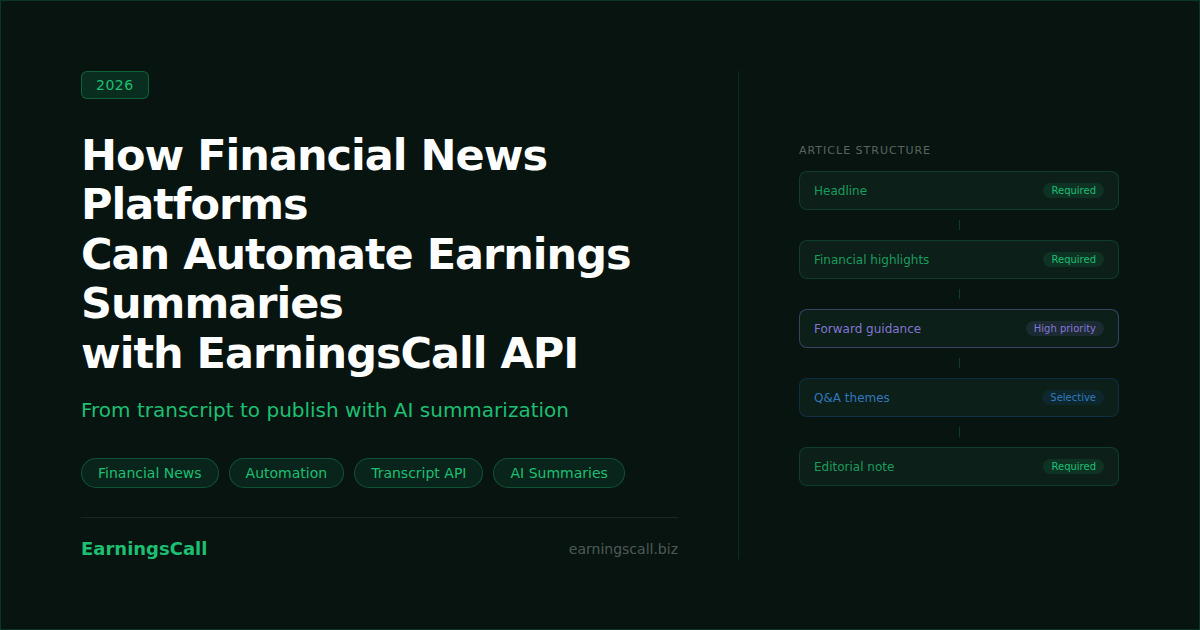
How Financial News Platforms Can Automate Earnings Summaries with EarningsCall API
Earnings calls happen on a fixed quarterly schedule, yet financial news coverage of them remains largely manual. A journalist or analyst listens to the call, takes notes, reads the transcript, pulls key quotes, and writes a summary. For a platform covering dozens of companies, that process repeats hundreds of times a quarter. For a platform aiming to cover thousands, it becomes operationally impossible without automation.
Financial news automation built on an earnings call summarization API and an earnings transcript API makes systematic coverage of earnings calls feasible at scale. This guide walks through how financial news platforms can build a pipeline that ingests structured transcript data, processes it through an AI summarization layer, and publishes ready-to-edit earnings content across a large company universe without proportional increases in editorial headcount.
Why Earnings Call Coverage Matters for Financial News Platforms
Earnings calls are among the highest-traffic events in financial media. Investors, analysts, and traders actively search for summaries, highlights, and management quotes within hours of a call ending. A financial news platform that covers earnings quickly and accurately captures that search and direct traffic consistently, quarter after quarter.
The problem is volume. There are approximately 4,000 earnings calls in a typical US quarter from publicly traded companies, concentrated heavily in a three-week window after each quarter closes. No editorial team can cover that volume manually at the speed the market expects. Most financial news platforms cover only the largest names, leaving the long tail of mid-cap and small-cap earnings entirely uncovered.
Research published through the National Bureau of Economic Research has consistently found that earnings call language carries forward-looking information that investors actively seek. The demand for timely earnings coverage is structural, not cyclical. Financial news automation addresses both the volume constraint and the timeliness problem simultaneously: automated pipelines process and publish earnings content within minutes of a transcript becoming available, regardless of how many companies report on the same day.
What Earnings Call Summarization Means for Financial Media
Earnings call summarization is the process of converting a structured transcript into a concise, readable summary that captures the most important information from the call. For financial media, that output typically covers financial highlights from the prepared remarks, key forward guidance statements, notable Q&A exchanges, and any notable shifts in language or tone compared to prior periods.
The distinction between automated and human summarization is not just speed. It is also consistency and coverage. A human summariser working under deadline pressure may miss a key comment buried in the Q&A. An automated pipeline processing the full transcript systematically will not. Consistency across many summaries also makes the output more useful for comparative research, since readers can trust that the same categories of information are covered in every summary across all companies.
EarningsCallNews.com demonstrates what this type of automated earnings news system looks like in practice. The platform generates financial news articles from earnings call transcripts using AI, covering companies across the public market universe with a consistent output format that readers can rely on for structured earnings intelligence.
The Earnings Transcript API as the Data Foundation
Financial news automation at scale requires a programmatic data source that provides consistent transcript access across a large company universe. The EarningsCall earnings transcript API covers 9,000+ public companies and returns structured transcript data through a Python SDK, making it the data layer for any earnings summarization pipeline.
import earningscall
from earningscall import get_company, get_calendar
from datetime import date

earningscall.api_key = "YOUR-API-KEY"

calendar = get_calendar(date(2026, 5, 1))

company = get_company("aapl")
transcript = company.get_transcript(year=2026, quarter=1)
At level 4 access, the transcript object separates prepared remarks from the Q&A section and includes speaker names and titles. This structured separation is foundational for earnings call summarization in a news context, because prepared remarks and Q&A carry different journalistic weight. Prepared remarks contain the scripted financial results and forward guidance. Q&A contains the unscripted management responses that often produce the most newsworthy content.
By processing the two sections separately, a summarization pipeline can generate a more useful output than treating the full transcript as an undifferentiated block of text. The prepared remarks section produces the financial headline and forward guidance summary. The Q&A section produces the analyst questions and management responses that are most likely to generate editorial interest.
For financial news platforms already building intelligence products on this data, How to Build and Launch an Earnings Intelligence SaaS with EarningsCall API covers the broader product architecture that a news automation pipeline can extend.
Building the Earnings Call Summarization API Pipeline
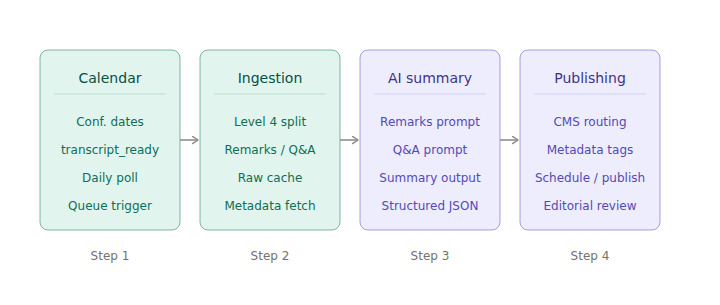
The earnings call summarization API pipeline for a financial news platform runs in four stages. Calendar monitoring detects upcoming calls and confirms transcript availability using the transcript_ready field. Transcript ingestion retrieves the structured content at level 4 access the moment availability is confirmed. AI summarization processes the transcript text and returns a formatted summary in a structure the publishing layer can use directly. Content publishing routes the summary to the CMS, adds required metadata, and schedules or immediately publishes the output.
from earningscall import get_company

company = get_company("aapl")
transcript = company.get_transcript(year=2026, quarter=1)

prepared_text = " ".join([s.text for s in transcript.prepared_remarks])
qa_text = " ".join([s.text for s in transcript.questions_and_answers])
The separation of prepared remarks and Q&A in the fetched object means the summarization prompt can be structured differently for each section, producing a more editorially useful output than a generic "summarize this document" instruction. Prepared remarks get a prompt targeting financial results, guidance, and management tone. Q&A gets a prompt targeting the most pointed analyst questions and the key management responses.
The publishing layer receives the summarization output alongside metadata from the transcript object: company name, ticker symbol, exchange, quarter, and conference date. These fields populate the article headline, byline metadata, and structured data markup without requiring any additional data sourcing step.
Content Quality in Financial News Automation
Financial news automation does not eliminate editorial judgment. It shifts where that judgment is applied. Instead of spending editorial time transcribing what happened on the call, editors review and refine automated output that already contains the key facts in a structured format.
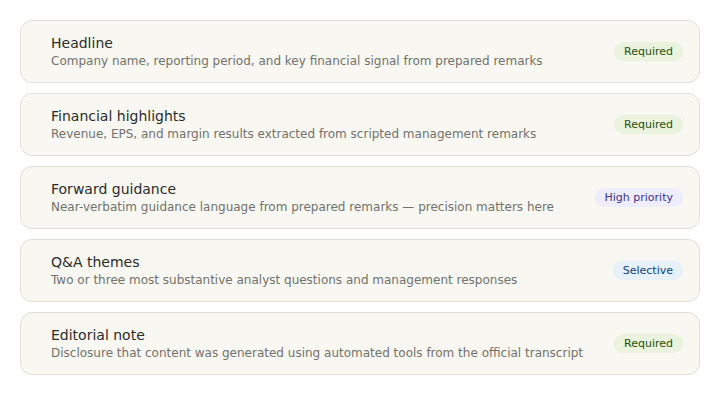
Five elements make up a well-structured automated earnings summary for a financial news platform.
The first is the headline. This should contain the company name, the reporting period, and a key financial signal from the call. An automated pipeline can generate headline options from the prepared remarks; the editor selects the most accurate and newsworthy.
The second is the financial highlights section. This covers revenue, earnings per share, and margin performance against prior-period results and analyst consensus. The transcript text contains these figures from management's scripted remarks; the summarisation layer extracts and formats them.
The third is the forward guidance summary. Management guidance language from the prepared remarks is often the most market-moving content of the call. The summarisation prompt should specifically target this section and return exact or near-exact guidance language rather than paraphrased versions, since precision matters in financial reporting.
The fourth is the Q&A themes section. Rather than summarising every question, the pipeline should identify the two or three analyst questions that received the longest or most substantive management responses. Those exchanges typically contain the most material content.
The fifth is an editorial note disclosing that the article was generated using automated tools from the official earnings call transcript. Transparency about automation maintains reader trust and satisfies journalistic standards for disclosure.
As Seeking Alpha's approach to earnings coverage shows, readers actively seek out earnings summaries and are less concerned with how they were produced than whether the key information is accurate and quickly available.
Scaling Automated Coverage Across the Full Universe
The structural advantage of an earnings transcript API pipeline is that marginal coverage cost does not increase with coverage breadth. Adding a hundred companies to the watchlist does not add proportional editorial work; it adds calendar and ingestion volume that the pipeline handles automatically.
For financial news platforms, this changes the editorial calculus fundamentally. Coverage decisions are no longer constrained by editorial bandwidth but by audience demand. If there is search traffic for mid-cap earnings summaries in a specific sector, the platform can add that sector to its coverage universe without hiring additional editorial staff.
The EarningsCall API's get_sp500_companies() function provides a starting point for S&P 500 coverage. Expanding to broader coverage is a matter of adding tickers to the watchlist and letting the ingestion and summarisation pipeline handle the additional volume.
from earningscall import get_sp500_companies

for company in get_sp500_companies():
    print(company.ticker_symbol, company.company_name)
For platforms that want to track language shifts across a company's earnings history alongside the current-quarter summary, How to Analyze CEO Language Patterns Over Time with EarningsCall API covers the longitudinal pipeline that can run in parallel with the news summarisation workflow.
For platforms building multi-company monitoring systems that route different company tiers to different editorial workflows, Automating Earnings Call Monitoring Across Portfolio Companies covers the watchlist architecture and output routing logic that applies equally to a news platform context.
FAQ
What is an earnings call summarization API?
An earnings call summarization API is a programmatic system that retrieves structured transcript data from earnings calls and processes it through an AI layer to generate readable summaries. For financial news platforms, this means automated generation of earnings articles at the moment a transcript becomes available, without requiring an editor to read the full transcript manually.
How does the EarningsCall earnings transcript API structure transcript data?
At level 4 access, the EarningsCall earnings transcript API returns the transcript as a structured object with prepared remarks and Q&A separated into distinct sections, each with speaker names and titles. This structure allows a summarization pipeline to process the two sections independently, producing more accurate and editorially useful output than treating the full transcript as a single block.
How quickly can an automated earnings summary be published after a call?
The pipeline from transcript availability to published article depends on summarization model latency and any editorial review steps. Without editorial review, the full pipeline from transcript_ready detection to published content can complete in under two minutes. With a light editorial review step, publication typically happens within fifteen to thirty minutes of transcript availability.
What disclosure is required for AI-generated financial news content?
Disclosure requirements vary by jurisdiction and publisher standards. Most established financial news operations disclose AI-generated or automated content through an editorial note at the end of the article, indicating that the content was generated using automated tools from the official earnings call transcript. This approach maintains transparency without reducing the utility of the content.
Can automated earnings summaries replace human financial journalists?
Automated earnings summaries handle the retrieval and formatting of factual content from transcripts. They do not replace the analytical judgment, sourcing, and contextualisation that distinguish high-quality financial journalism. The most effective use of earnings call summarization automation is to free editorial teams from low-value transcript extraction tasks so they can focus on analysis, commentary, and sourcing.
Conclusion
Financial news automation built on an earnings call summarization API and earnings transcript API from EarningsCall changes the economics of earnings coverage for financial news platforms. Coverage decisions become demand-driven rather than capacity-constrained. Transcript-to-publish latency drops from hours to minutes. Editorial effort shifts from extraction to review and analysis.
The pipeline described in this guide handles the data sourcing and content generation layers that previously required the most editorial time. The EarningsCall API provides 9,000+ company coverage through a consistent SDK interface; the AI summarization layer processes prepared remarks and Q&A into structured news content; the publishing layer routes that content to whatever CMS or distribution channel the platform uses. The editorial team owns the quality control and contextualisation layer that ensures the output meets the platform's standards.
For full API documentation and SDK integration guides, visit the EarningsCall developer guide. For company filings and supplemental financial data, SEC EDGAR is the primary public resource.