How to Build and Launch an Earnings Intelligence SaaS with EarningsCall API
Financial data is one of the most consistently monetisable categories in SaaS. Investors, analysts, portfolio managers, and fintech developers all pay for structured access to information they cannot reliably source themselves. Earnings call transcripts sit at the centre of that market: they are produced quarterly, attributable to specific companies, structured enough to process programmatically, and rich enough in signal to support a wide range of product types.
An earnings intelligence SaaS built on the EarningsCall developer earnings API gives a fintech SaaS builder direct access to that data layer without building transcript ingestion infrastructure from scratch. This guide walks through how to architect, build, and launch an earnings intelligence product, from the data foundation to packaging, pricing, and go-to-market.
What Earnings Intelligence SaaS Products Look Like
Before building anything, it helps to understand the product landscape. Earnings intelligence SaaS is a broad category, and the architecture and go-to-market approach differ significantly depending on which segment a builder targets.
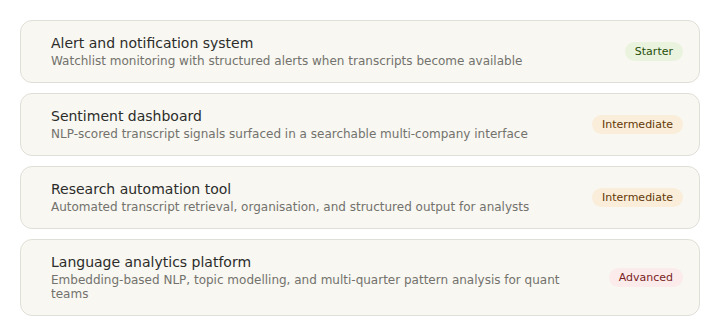
The simplest products are alert and notification systems. These deliver structured notifications when a company in a user's watchlist reports, when a transcript is available, or when a language signal in a transcript deviates from that company's historical baseline. The core value proposition is time savings: the user learns what they need to know faster than they would through manual monitoring.
Dashboard products go a level deeper. They pull transcript data continuously across a defined coverage universe, run NLP scoring on each call, and surface the results in a searchable interface where users can compare companies, track trends over time, and drill into specific calls. These products serve analysts and portfolio managers who want structured intelligence rather than raw transcript access.
Research automation tools target professional users who currently spend significant time on manual earnings research. The product handles the retrieval, organisation, and initial processing of transcript data, delivering output in a format the analyst can use immediately rather than spend hours to produce manually.
Language analytics platforms are the most technically sophisticated category. They apply embedding-based NLP, topic modelling, and multi-quarter comparison to surface patterns that are not visible in individual transcript review. These products typically serve quant teams and research-oriented institutional clients.
Choosing a Developer Earnings API as Your Data Foundation
The quality of an earnings intelligence SaaS product depends almost entirely on the quality of its data foundation. A developer earnings API that provides inconsistent coverage, unreliable transcript timing, or poorly structured output creates technical debt that compounds at the product layer.
EarningsCall solves the data sourcing problem with a Python SDK and JavaScript SDK covering 9,000+ public companies. The Python SDK provides everything a fintech SaaS builder needs for a production data layer: transcript retrieval by company, year, and quarter, a calendar endpoint for monitoring upcoming calls, a get_sp500_companies() function for building coverage universes, and retry logic with exponential backoff for handling rate limiting during peak earnings periods.
import earningscall
from earningscall import get_company, get_calendar, get_sp500_companies
from datetime import date
 earningscall.api_key = "YOUR-API-KEY"  company = get_company("aapl") transcript = company.get_transcript(year=2026, quarter=1) calendar = get_calendar(date(2026, 5, 1))
At level 4 access, the transcript object separates prepared remarks from Q&A and includes speaker names and titles. This structured format is the foundation that makes the intelligence layer work: you cannot build a reliable sentiment signal or CEO language tracker without knowing who said what in which section of the call.
For builders who prefer JavaScript, the EarningsCall SDK supports TypeScript:
import { getCompany, setApiKey } from "earningscall"; setApiKey("YOUR-API-KEY"); const company = await getCompany({ symbol: "AAPL" });For builders already working on research automation use cases, How Independent Analysts Can Cut Research Time with EarningsCall API covers the data access patterns that apply equally to a SaaS product context.
Building the Earnings Intelligence SaaS Architecture
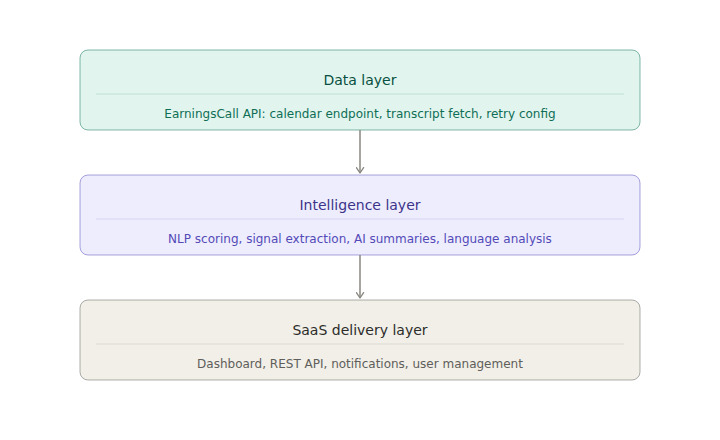
An earnings intelligence SaaS built on a developer earnings API follows a three-layer architecture. Understanding each layer's responsibilities before writing code prevents the most common SaaS rebuild cycles.
The data layer handles all interaction with EarningsCall. It is responsible for calendar polling, transcript retrieval, caching raw transcript content, and managing retry logic. The data layer should be stateless and idempotent: re-running any ingestion job should produce the same output regardless of when it runs. Storing raw transcript objects in their original structure before any processing means the intelligence layer can be updated and re-run against existing data without re-fetching from the API.
The intelligence layer reads from the cached raw transcripts and produces derived signals. Depending on the product type, this layer might run hedge word frequency scoring, compute sentiment polarity, extract CEO-specific language, or generate natural language summaries. The intelligence layer should be independently deployable from the data layer, so that NLP models and scoring logic can be updated without touching the ingestion pipeline.
The SaaS delivery layer is what users see and pay for. This might be a web dashboard, a REST API that exposes your derived signals to other developers, a notification system that pushes alerts to email or Slack, or a combination of all three. The key architectural decision is whether to serve your intelligence signals directly or to expose them as an API that lets customers build on top of your product. A fintech SaaS builder targeting developer customers should consider the API route; one targeting non-technical analyst users should prioritise the dashboard experience.
Sourcing Data Across a Coverage Universe
The EarningsCall developer earnings API covers 9,000+ companies, but most earnings intelligence SaaS products serve users with focused coverage needs. Three patterns work well for different product segments.
The watchlist model gives each user a personal company list, and the product monitors only those companies for each user. This is the simplest approach and scales well because ingestion volume scales with user watchlist size rather than with the full coverage universe.
The sector model pre-defines coverage groups (technology, healthcare, financial services) and ingests all companies within each group continuously. Users subscribe to the sectors relevant to them. This approach supports the digest and comparison features that make dashboard products compelling but requires more infrastructure at the data layer.
The full-universe model ingests and processes transcripts across the entire EarningsCall coverage universe each quarter. This supports the most powerful product experiences, including cross-company comparison, sector benchmarking, and market-wide language trend detection. It also requires the most robust infrastructure, particularly during peak earnings season when transcript volume concentrates into a narrow time window.
Academic research published through the National Bureau of Economic Research has consistently found that earnings call language carries information beyond the numerical content of the same communications. For a fintech SaaS builder, that finding translates directly into product value: users will pay for a product that gives them systematic access to that additional signal.
How Fintech SaaS Builders Package Intelligence Products
Packaging is where many technically excellent earnings intelligence SaaS products underperform commercially. The intelligence output is strong, but the packaging does not match how the target customer thinks about the problem or how they currently spend their research budget.
Three packaging decisions matter most for a fintech SaaS builder in this space.
The first is the unit of value. Some customers pay for access (give me all the transcripts), some pay for intelligence (give me scores and signals), and some pay for workflow integration (deliver the right alert at the right time in the right channel). These are different products at different price points. A developer earnings API wrapper that charges per transcript is competing on data access; a product that delivers structured intelligence signals charges for the analytical work on top of the raw data.
The second is the delivery format. Web dashboards require ongoing product investment in UX. REST APIs require developer documentation and support. Notification systems require reliability infrastructure. The format that best matches the technical maturity of the founding team should be the initial focus, with other formats added as the product matures.
The third is the coverage tier structure. Most successful earnings intelligence SaaS businesses offer a free tier covering a limited company universe (for example, S&P 500 only, or a user-defined watchlist of up to ten companies), a professional tier covering a broader universe with more signal types, and an enterprise tier with custom coverage, higher API limits, and dedicated support. The free tier drives discovery and trial; the professional tier drives initial revenue; the enterprise tier drives significant account expansion.
For teams building intelligence products on top of transcript data for institutional clients, Automating Earnings Call Monitoring Across Portfolio Companies shows the enterprise-oriented architecture that informs how the most demanding customer segment wants data delivered.
Going to Market as a Fintech SaaS Builder
A fintech SaaS builder launching an earnings intelligence SaaS competes in a market where the incumbents are expensive, slow-moving, and primarily serve large institutional clients. That competitive landscape creates significant opportunity at the mid-market and developer segments, but also requires a go-to-market approach calibrated to those segments specifically.
Developer-first distribution works well for API products and technical tools. Publishing documentation, posting on developer forums, and writing technical content demonstrating how the product works generates inbound traffic from the audience most likely to evaluate and adopt the product. Seeking Alpha and similar financial communities also surface tools to investment professionals who are not developers but are actively looking for research efficiency improvements.
Analyst-first distribution works better for dashboard and notification products. Outreach to independent analysts, investment newsletter authors, and small investment teams produces faster sales cycles than enterprise sales, with enough volume to validate product-market fit before investing in enterprise infrastructure.
For research-oriented products targeting academic or institutional users, the Journal of Finance and affiliated working paper communities are distribution channels that very few SaaS founders use, despite the concentrated presence of buyers who are specifically interested in earnings call language data.
For builders who want to understand how CEO language analysis specifically can anchor a research-oriented product, How to Analyze CEO Language Patterns Over Time with EarningsCall API covers the longitudinal pipeline architecture that supports the most premium product tiers.
FAQ
What is an earnings intelligence SaaS?
An earnings intelligence SaaS is a software product that processes earnings call transcript data programmatically and delivers derived signals, summaries, alerts, or analytics to paying customers. These products typically sit between a raw data provider like EarningsCall and end users who need structured intelligence rather than raw transcript access.
Why use a developer earnings API instead of building transcript ingestion from scratch?
Building a reliable transcript ingestion pipeline from scratch requires maintaining scrapers, handling inconsistent source formats, managing reliability across thousands of company investor relations pages, and solving timing problems around when transcripts are published. A developer earnings API like EarningsCall solves all of these problems, providing consistent structured access through a maintained SDK so the product team can focus on the intelligence and delivery layers where the product's value actually lives.
What technical stack does a fintech SaaS builder need for this type of product?
The EarningsCall API is accessible via Python and JavaScript SDKs. The data layer can be built in either language. The intelligence layer typically uses Python for NLP processing. The delivery layer depends on the product format: web dashboards use standard web frameworks, API products require a REST framework, and notification systems use email or Slack integration libraries. The full stack is straightforward for a solo developer or small team.
How many companies does the EarningsCall API cover?
The EarningsCall developer earnings API covers 9,000+ public companies. The Python SDK includes a get_sp500_companies() function for S&P 500 coverage and supports lookup by ticker symbol for any company in the coverage universe.
What is the fastest viable product for a first earnings intelligence SaaS launch?
An earnings alert and notification system is the lowest-complexity viable product: poll the calendar endpoint for a user's watchlist, detect when transcript_ready becomes true, and send a structured notification. This product has immediate value, requires minimal infrastructure, and creates a usage habit that supports expansion into more sophisticated intelligence features over time.
Conclusion
An earnings intelligence SaaS built on the EarningsCall developer earnings API gives a fintech SaaS builder the data foundation that would otherwise take months to construct independently. The intelligence layer, the delivery format, the packaging, and the go-to-market approach are where the product's value and differentiation are built. The data sourcing problem is solved by the API.
The market for earnings intelligence products is underserved at the mid-market and developer segments. The institutional incumbents are expensive, slow to innovate, and not focused on the independent analyst, small fund, or development team use cases where the EarningsCall API is most competitive. For a fintech SaaS builder with a focused product thesis and a target customer in mind, the combination of accessible transcript data, a maintained Python and JavaScript SDK, and 9,000+ company coverage provides everything needed to build and launch a viable earnings intelligence SaaS product.
For full API documentation and SDK integration guides, visit the EarningsCall developer guide. For company filings and supplemental financial data, SEC EDGAR is the primary public resource.