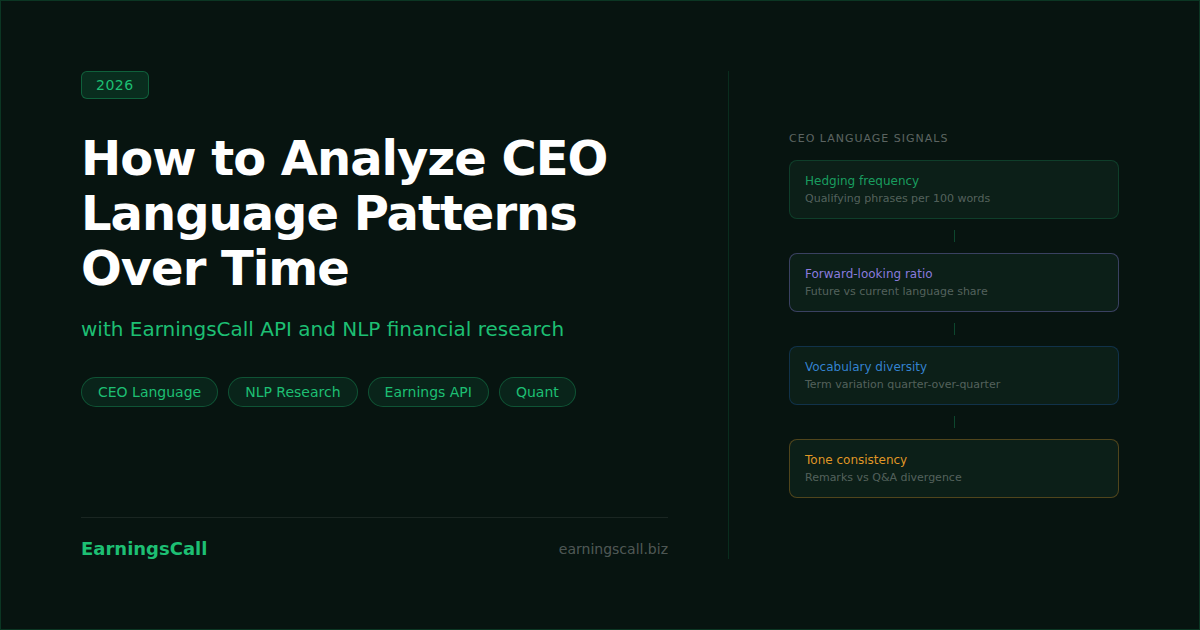
How to Analyze CEO Language Patterns Over Time with EarningsCall API
The words a CEO chooses on an earnings call are not incidental. They are the output of a communication process that reflects confidence, caution, institutional posture, and forward outlook simultaneously. Over multiple years, those word choices accumulate into a pattern that can be studied systematically, revealing how a leader's language shifts in response to business conditions, strategic pivots, and external pressure.
CEO language analysis has become an active area in both academic finance and applied investment research. The availability of programmatic transcript access through an earnings call research API has made longitudinal studies of this kind feasible at scale for the first time. This guide walks through how to build a multi-year CEO language dataset, extract CEO-specific text from structured transcripts, and apply NLP financial research techniques to identify patterns across a full leadership tenure.
Why CEO Language Analysis Matters for Financial Research
Language carries information that numbers alone do not. A quarterly revenue figure tells you what happened. The words a CEO uses to describe that figure, and the words they use when analysts press for elaboration, tell you something about what they expect will happen next.
Research published through the National Bureau of Economic Research has documented systematic relationships between the linguistic content of earnings communications and subsequent firm outcomes. Studies examining hedging language, forward-looking statement density, and tone consistency have found that these signals carry predictive information about earnings revisions, guidance accuracy, and stock return volatility beyond what numerical disclosures contain.
For NLP financial research, the earnings call is a particularly high-quality data source because it is structured, recurring, and attributable to specific speakers. Unlike press releases or annual reports, where language is produced by committees and communication teams, the Q&A portion of an earnings call captures unscripted CEO responses under analyst questioning. This combination of scripted and unscripted content in the same session makes CEO language analysis on earnings transcripts unusually rich as a research input.
What CEO Language Analysis Measures Over Time
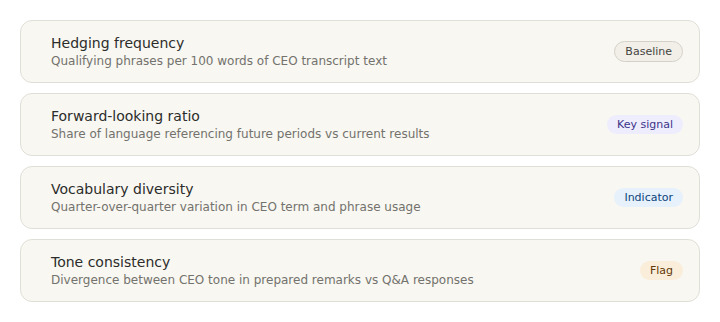
Before building a pipeline, it helps to define the specific signals a longitudinal CEO language analysis should track. Four categories cover most of what changes meaningfully over time.
The first is hedging frequency: the proportion of qualifying phrases such as "subject to," "we believe," "pending conditions," and "depending on execution" per hundred words. A rising hedge rate across quarters often correlates with deteriorating management confidence even when numerical guidance remains flat.
The second is forward-looking language density: the share of transcript text that references future periods using tense markers and temporal indicators. CEOs who are confident about near-term prospects tend to front-load forward guidance; those who are uncertain tend to anchor language in the current period.
The third is vocabulary diversity: a measure of how much the CEO's language varies quarter over quarter. Heavy reliance on repeated phrases and scripted formulations can signal either a disciplined communications strategy or a narrowing of genuine informational content. Tracking which one it is requires longitudinal context.
The fourth is tone consistency between prepared remarks and Q&A responses. A CEO whose tone shifts significantly from the scripted section to the analyst questioning section is showing a pattern worth flagging, particularly if the shift occurs on specific topic areas quarter after quarter.
Sourcing Data for NLP Financial Research with EarningsCall API
The core challenge in longitudinal CEO language analysis is data sourcing at scale. Assembling ten or more years of quarterly transcripts for even a single company through manual methods is impractical. Doing it for a full research dataset covering dozens of companies makes the problem computationally intractable without a programmatic data layer.
The EarningsCall earnings call research API provides this layer. The Python SDK supports transcript retrieval by company, year, and quarter, covering 9,000+ public companies. Historical transcripts can be retrieved using the same call structure as current-period transcripts, which means the same pipeline handles both archival research and forward-going monitoring without modification.
import earningscall
from earningscall import get_company

earningscall.api_key = "YOUR-API-KEY"

company = get_company("aapl")

for year in range(2015, 2026):
    for quarter in [1, 2, 3, 4]:
        transcript = company.get_transcript(year=year, quarter=quarter)
        if transcript:
            print(f"Q{quarter} {year}: transcript retrieved")
This retrieves up to forty-four quarters of transcript data for a single company in a single loop. Scaling to a full research dataset of thirty companies is a matter of an outer loop over the ticker list. The consistent structure of the returned transcript objects means downstream processing can be standardised across all companies and time periods without custom parsing logic.
For context on how this same API structure supports investment-focused workflows, Using Earnings Call Transcripts to Reduce Portfolio Risk covers the pipeline architecture from a quantitative risk perspective.
Extracting CEO-Specific Language from Transcript Data
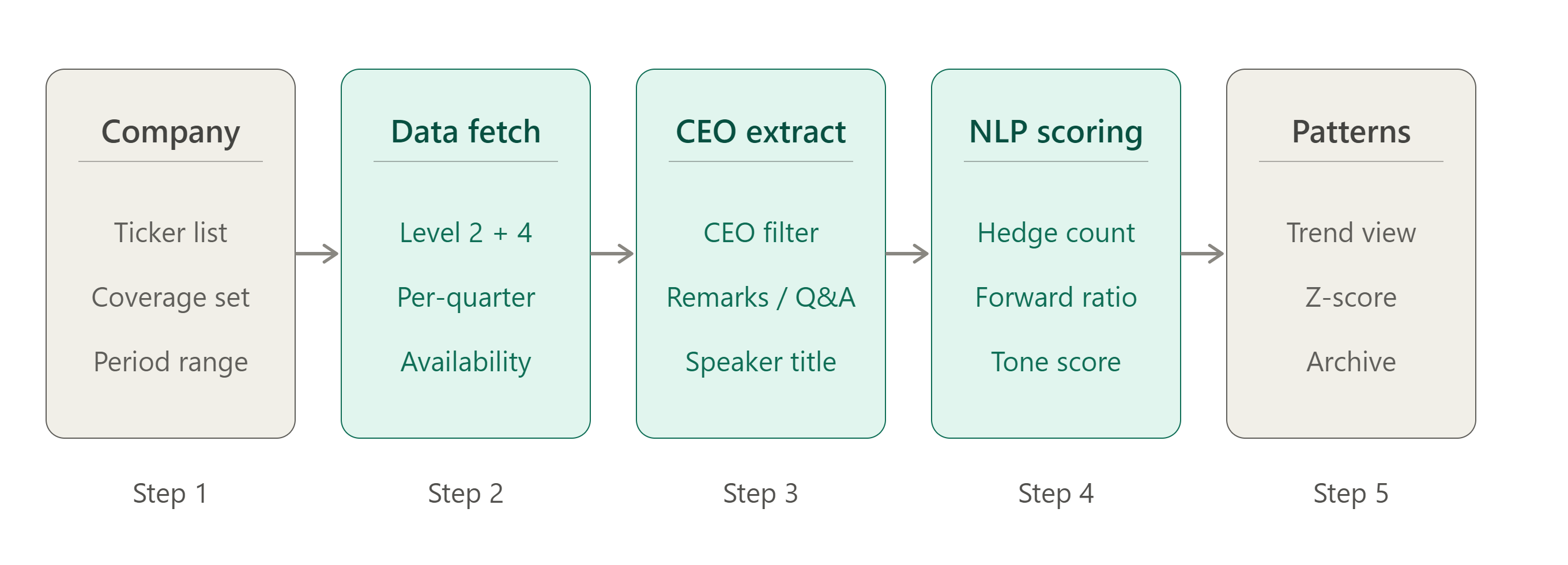
The EarningsCall API at level 2 returns speaker names and titles alongside each statement in the transcript. This is the structural feature that makes CEO-specific extraction possible programmatically. Without speaker identification, a researcher would need to infer CEO statements from context or positional heuristics, both of which introduce noise.
At level 4 access, the transcript object separates prepared remarks from the Q&A section. For CEO language analysis, treating these sections independently is important. Prepared remarks reflect scripted, reviewed language that the CEO and their communications team have polished. Q&A responses are spontaneous and unscripted. The two sections carry different types of information and should be scored separately before being combined into a composite signal.
from earningscall import get_company

company = get_company("msft")
transcript = company.get_transcript(year=2026, quarter=1)

ceo_remarks = [
    s for s in transcript.prepared_remarks
    if "ceo" in s.speaker_info.title.lower() or
       "chief executive" in s.speaker_info.title.lower()
]

ceo_qa = [
    s for s in transcript.questions_and_answers
    if "ceo" in s.speaker_info.title.lower() or
       "chief executive" in s.speaker_info.title.lower()
]
Filtering on speaker title rather than name is more robust for longitudinal research, since the CEO may change across the dataset window. A title-based filter captures language from whoever holds the role in each period, which is the correct unit of analysis for studying the position rather than the individual.
Applying NLP Financial Research Techniques to CEO Transcripts
With a structured CEO-specific text corpus assembled, NLP financial research techniques can be applied systematically across the dataset. The specific methods depend on the research question, but several approaches are well-established in the literature.
Dictionary-based scoring is the most interpretable approach and the easiest to reproduce. A custom hedge word list, trained on financial transcript text, counts qualifying phrases per hundred words of CEO speech. The same method applies to forward-looking language, where a list of tense markers and temporal expressions is used to calculate what proportion of the CEO's words reference future periods. Studies published in the Journal of Finance have used similar dictionary-based approaches to document the relationship between earnings call language and subsequent analyst forecast revisions.
Embedding-based similarity analysis is more computationally demanding but captures something dictionary methods miss. By representing each quarter's CEO transcript as a dense vector and measuring cosine similarity between consecutive quarters, a researcher can detect when a CEO's language shifts significantly without specifying in advance what words or phrases to look for. A sudden drop in similarity between Q3 and Q4 of a given year is a signal worth investigating, regardless of whether any specific hedge word frequency changed.
Topic modelling across the full dataset reveals which themes a CEO discusses and how the weight of those themes shifts over time. A CEO who spent 40 percent of their prepared remarks discussing international growth in 2018 and 5 percent in 2022 has communicated a strategic shift through language, independent of any formal announcement. NLP financial research methods make this kind of shift detectable and measurable.
Building the Longitudinal Earnings Call Research API Dataset
Several operational decisions shape how well a longitudinal CEO language analysis dataset holds up for research purposes.
The first is consistent transcript access level. Running level 2 access for some quarters and level 1 for others creates structural inconsistencies in the data: speaker attribution will be missing for some periods, making CEO-specific filtering unreliable. Fixing the access level across the full dataset before ingestion is worth the planning overhead.
The second is handling CEO transitions. When a new CEO takes over mid-year, the dataset will contain transcripts featuring two different individuals in the same role. Flagging transition quarters explicitly in the dataset allows downstream analysis to exclude them or treat them as a special category rather than treating the language shift as a CEO communication signal.
The third is rate handling during bulk historical retrieval. The EarningsCall SDK includes configurable retry logic with exponential backoff, which is particularly important during a bulk historical pull where hundreds of API calls may be made in sequence. Configuring this correctly at the ingestion stage prevents partial dataset builds caused by rate limit failures.
For teams who want to extend this kind of dataset into an ongoing monitoring system that delivers alerts when new transcripts are available, Build an Earnings Call Alert System with EarningsCall API and Claude covers the real-time notification layer that can sit on top of the same data infrastructure.
For independent researchers building their first longitudinal transcript dataset, How Independent Analysts Can Cut Research Time with EarningsCall API covers the foundational workflow setup that scales to this kind of multi-year project.
FAQ
What is CEO language analysis in financial research?
CEO language analysis is the systematic study of how chief executives communicate across earnings calls over time, using NLP techniques to measure linguistic signals such as hedging frequency, forward-looking language density, tone consistency, and vocabulary diversity. The goal is to surface patterns that carry information about management outlook and firm risk beyond what numerical disclosures contain.
Why use earnings calls for NLP financial research rather than other disclosures?
Earnings calls combine scripted prepared remarks with unscripted Q&A responses in the same session, attributable to specific named speakers including the CEO. This structure makes them a particularly rich source for NLP financial research because the contrast between scripted and unscripted language is analytically meaningful and consistently available quarter over quarter across thousands of public companies.
How many years of historical transcript data can the EarningsCall API provide?
The EarningsCall earnings call research API supports retrieval by year and quarter across its coverage universe of 9,000+ public companies. Historical availability varies by company. The same SDK function used for current-period transcripts handles historical retrieval without modification.
How do you extract CEO-specific text from an earnings call transcript?
At level 2 access, the EarningsCall API returns speaker names and titles alongside each statement. Filtering on title fields containing "CEO" or "chief executive" extracts CEO-specific statements from both the prepared remarks and Q&A sections. At level 4, these sections are returned as separate objects, enabling section-specific scoring.
Is dictionary-based scoring or embedding-based analysis better for CEO language analysis?
Both have distinct strengths. Dictionary-based scoring is interpretable, reproducible, and easy to audit, making it well-suited for research contexts where explainability matters. Embedding-based similarity analysis captures shifts that dictionary methods miss, including topic drift and stylistic change, but requires more computational infrastructure. A longitudinal research dataset benefits from running both in parallel.
Conclusion
CEO language analysis across multiple years requires three things: consistent transcript data at speaker-level resolution, a structured extraction method that separates CEO statements from other participants, and NLP financial research techniques calibrated for the specific signals a longitudinal study needs to track.
The EarningsCall earnings call research API handles the first requirement through its Python SDK, which retrieves historical transcripts by year and quarter using the same structure as current-period calls. The level 2 and level 4 access tiers provide the speaker identification and section separation that the extraction layer depends on. The NLP layer, whether dictionary-based, embedding-based, or both, sits on top of this foundation and can be iterated without rebuilding the data infrastructure beneath it.
For researchers, this means a longitudinal CEO language dataset that previously required months of manual transcript sourcing can now be assembled in hours, leaving the majority of research time for the analysis itself.
For full API documentation and SDK integration guides, visit the EarningsCall developer guide. For company filings and supplemental financial data, SEC EDGAR is the primary public resource.