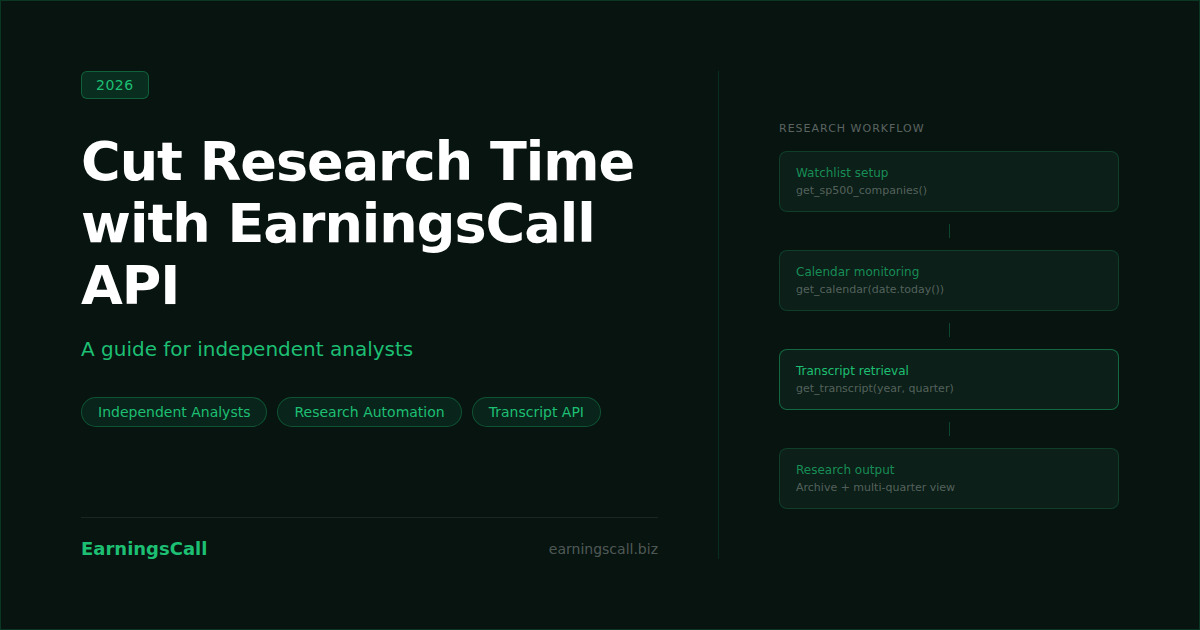
How Independent Analysts Can Cut Research Time with EarningsCall API
Independent analysts work without the infrastructure of a bank or asset manager. No Bloomberg terminal team. No research division to share the workload. Every piece of analysis is assembled from scratch, which makes the efficiency of the research process itself a competitive variable.
Earnings calls sit at the center of fundamental equity research. They are the primary event where management communicates current results and forward direction directly, unfiltered by intermediaries. For an independent analyst covering a meaningful number of companies, manually tracking calls, sourcing transcripts, reading through prepared remarks and Q&A, and building coherent notes is one of the most time-consuming recurring tasks in the workflow.
Earnings call research automation built on the EarningsCall earnings transcript API changes that dynamic. This guide walks through how independent analysts can build a personal research system that handles the routine parts of earnings research programmatically, freeing analytical bandwidth for judgment and synthesis rather than information retrieval.
Why Earnings Research Takes So Long Without Automation
The time cost of earnings research for independent analysts is not concentrated in a single step. It is distributed across a chain of small tasks that compound across a full coverage universe each quarter.
Tracking which companies are reporting and when requires maintaining a separate calendar or checking multiple financial sites. Sourcing transcripts after a call means checking aggregators, company investor relations pages, or paid services. Reading through a full transcript to find the passages that matter requires either reading the whole thing or knowing exactly which keywords to scan for. Building a comparison across multiple quarters requires either memory or a manually maintained spreadsheet.
None of these steps is intellectually demanding on its own. Together they consume a disproportionate share of a working day that an independent analyst cannot recover by delegating to a junior team member.
Earnings call research automation addresses the retrieval and organisation layer entirely, so the analyst's attention can start at the point where interpretation is required rather than at the point where information needs to be found.
What an Earnings Transcript API Does for Independent Analysts
An earnings transcript API provides programmatic access to structured transcript data across a broad company universe. Instead of sourcing each transcript manually, an analyst can write a script once and retrieve structured content for any company in the coverage universe on demand.
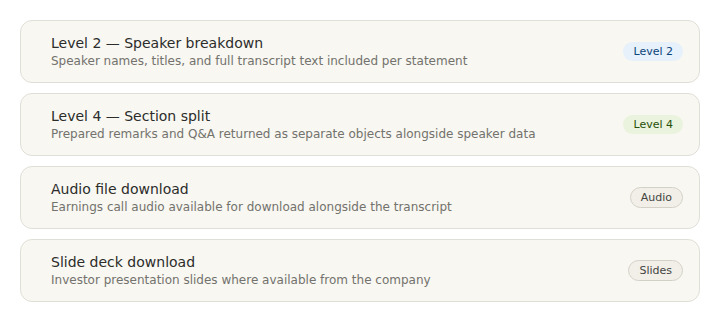
The EarningsCall API covers 9,000+ public companies and returns transcripts at multiple access levels. At level 2, transcripts include speaker names and titles alongside the text. At level 4, the transcript object separates prepared remarks from the Q&A section, which is the structural split most useful for research workflows where scripted management commentary and off-script analyst responses serve different analytical purposes.
import earningscall
from earningscall import get_company

earningscall.api_key = "YOUR-API-KEY"

company = get_company("aapl")
transcript = company.get_transcript(year=2026, quarter=1)
Beyond transcripts, the API provides access to earnings call audio files and slide decks where available, which means an independent analyst can build a complete earnings call archive for every company they cover without visiting a single investor relations page.
For analysts already using transcript data to track language signals across quarters, Using Earnings Call Transcripts to Reduce Portfolio Risk: A Quant Approach covers how language-based signals can be layered into a risk monitoring framework.
Building an Earnings Call Research Automation Workflow
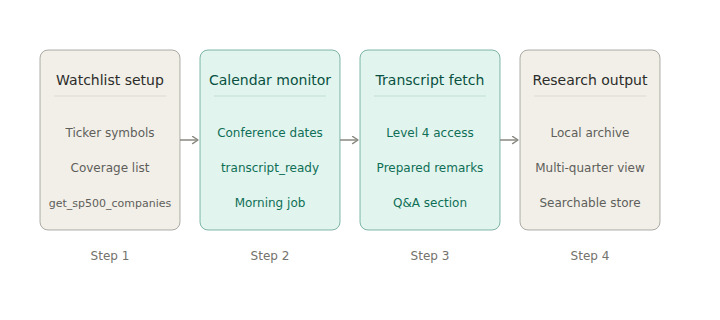
The research automation workflow for an independent analyst runs in four stages. The first is watchlist setup: defining the coverage universe and registering it as a list of ticker symbols. The second is calendar monitoring: polling the EarningsCall calendar to detect upcoming calls and transcript availability. The third is transcript retrieval: fetching structured content the moment a transcript is available. The fourth is research output: storing, comparing, and summarising the retrieved data.
Each stage can be implemented incrementally. Starting with calendar monitoring alone eliminates one of the most tedious parts of the workflow. Adding transcript retrieval on top of that means every call in the coverage universe is automatically captured without a manual sourcing step.
Stage one: watchlist setup. The EarningsCall Python SDK includes a get_sp500_companies() function for analysts who want to track the full S&P 500 as a starting point. For a focused coverage list, a simple text file of ticker symbols is all that is needed.
from earningscall import get_sp500_companies

for company in get_sp500_companies():
    print(company.ticker_symbol, company.company_name)
Stage two: calendar monitoring. The calendar endpoint returns upcoming conference dates, company names, and the transcript_ready field for each scheduled call. A morning job checking the calendar for the next seven days surfaces every upcoming call across the coverage universe without any manual checking.
from earningscall import get_calendar
from datetime import date

calendar = get_calendar(date(2026, 5, 1))
Stage three: transcript retrieval. When transcript_ready becomes true, the transcript fetch is triggered automatically. At level 4, the returned object separates prepared remarks from Q&A, making it straightforward to store the two sections independently for analysis.
Stage four: research output. Fetched transcripts are written to a local database or file store, timestamped by company and quarter. This creates a searchable archive that grows automatically each earnings season, enabling multi-quarter comparisons without any manual file management.
Using the Earnings Transcript API for Multi-Quarter Research
One of the highest-value applications of an earnings transcript API for independent analysts is multi-quarter comparison. Understanding how a company's language has shifted across four to eight quarters, whether management is growing more or less confident about a specific segment, whether guidance language has tightened or loosened, requires access to historical transcripts in a consistent format.
Building that archive manually is impractical. Sourcing and reformatting transcripts from different providers or investor relations pages quarter by quarter introduces inconsistency that makes comparison difficult. An earnings transcript API that returns consistently structured data across all historical periods solves this at the retrieval layer.
from earningscall import get_company

company = get_company("msft")

for year in [2025, 2026]:
    for quarter in [1, 2, 3, 4]:
        transcript = company.get_transcript(year=year, quarter=quarter)
        if transcript:
            print(f"Q{quarter} {year}: {len(transcript.prepared_remarks)} chars")
This pattern retrieves eight consecutive quarters of prepared remarks for a single company in seconds. Scaling it to a full coverage list of twenty to thirty names is a matter of looping over the watchlist. The same logic works for any analyst who wants to track language drift, guidance consistency, or topic frequency across a company's earnings history.
For analysts who want to push the retrieval step further and add automated alert delivery on top, Build an Earnings Call Alert System with EarningsCall API and Claude covers the full notification pipeline including Claude-generated summaries delivered the moment a transcript is available.
Practical Research Patterns for Independent Analysts
Several practical patterns emerge from working with the EarningsCall API across a full coverage universe.
The first is a sector-level digest. Instead of reviewing each company in a sector individually, an analyst can retrieve all transcripts for the sector in a single batch job at the end of each reporting week, store them in a consistent format, and run a keyword or language scan across the full set. This surfaces cross-company themes, shared language around macro conditions, and outliers whose tone diverges from peers, in a fraction of the time that manual reading would take.
The second is a watchlist alert. Setting up a simple poll of transcript_ready across the coverage universe means the analyst is notified the moment each transcript is available rather than checking manually. Combined with automated retrieval, this ensures the research database is always current without active monitoring.
The third is an earnings season dashboard. Because the calendar endpoint returns the full schedule for any date window, it is straightforward to build a personal dashboard showing which companies in the coverage universe are reporting in the next two weeks, which transcripts are already available, and which are pending. Independent analysts who cover both large-cap and mid-cap names benefit significantly from this kind of consolidated view.
As Seeking Alpha's coverage of independent equity research has noted, the ability to process more data systematically is increasingly what distinguishes well-resourced independent analysis from purely ad-hoc approaches. The EarningsCall API provides the data layer that makes systematic processing practical at the individual analyst level.
For independent analysts interested in extending this workflow with sentiment signals, How to Build a Hedge Fund Earnings Sentiment Dashboard covers the NLP scoring layer that can sit on top of the same transcript data.
FAQ
What is earnings call research automation for independent analysts?
Earnings call research automation refers to building a programmatic workflow that handles the retrieval, organisation, and initial processing of earnings call transcripts automatically, so independent analysts spend their time on interpretation and synthesis rather than manual sourcing and file management.
What companies can an independent analyst access through the EarningsCall API?
The EarningsCall API covers 9,000+ public companies through a Python SDK and JavaScript SDK. The API includes a get_sp500_companies() function for S&P 500 coverage and supports lookup by ticker symbol for any company in the coverage universe.
Does the earnings transcript API provide historical transcripts?
Yes. The EarningsCall API supports transcript retrieval by year and quarter, enabling analysts to build multi-quarter archives for any company in the coverage universe. This makes multi-quarter language comparison and trend analysis practical without manual transcript sourcing.
What is the difference between prepared remarks and Q&A in an earnings transcript?
Prepared remarks are scripted statements delivered by management at the start of the call, covering results and guidance. Q&A is the unscripted exchange with analysts that follows. At level 4 access, the EarningsCall API returns these as separate objects, which makes it straightforward to analyse the two sections independently.
Can an independent analyst use the EarningsCall API without a development background?
The EarningsCall Python SDK is designed to minimise setup. The NBER working paper literature on textual analysis of corporate disclosures shows that even basic keyword analysis of transcript text produces useful signals, and the SDK makes transcript retrieval straightforward enough that analysts with basic Python familiarity can build a functional research workflow without specialist engineering support.
Conclusion
The case for earnings call research automation is strongest for independent analysts, precisely because the time cost of manual research falls entirely on one person rather than being distributed across a team. An earnings transcript API does not replace the analytical judgment that makes independent research valuable. It eliminates the retrieval and organisation overhead that sits in front of it.
The EarningsCall API provides the data foundation: consistent, structured transcript access across 9,000+ companies, a calendar endpoint for monitoring upcoming calls, and SDK support in Python and JavaScript. The workflow patterns in this guide are starting points. The research infrastructure an independent analyst builds on top of them compounds in value each quarter as the transcript archive grows and multi-quarter comparison becomes possible across the full coverage universe.
For full API documentation and SDK integration guides, visit the EarningsCall developer guide. For company filings and supplemental financial data, SEC EDGAR is the primary public resource.