Automating Earnings Call Monitoring Across Portfolio Companies with EarningsCall API
Private equity firms track public company earnings calls for reasons that go well beyond ownership. Comparable company analysis, sector intelligence, competitive benchmarking, and exit planning all depend on understanding what publicly traded peers are saying about their markets, their cost structures, and their forward outlook. For a PE investment team covering multiple sectors and dozens of comparable companies per sector, manually tracking earnings calls is unsustainable at any meaningful scale.
An earnings call monitoring API built on the EarningsCall platform makes systematic monitoring across a large company universe operationally practical. This guide walks through how PE teams and portfolio analysts can build a portfolio monitoring API pipeline that captures transcripts automatically, extracts relevant signals, and delivers structured intelligence across the full comparable universe, without manual intervention each earnings season.
Why Private Equity Financial Data Teams Monitor Earnings Calls
Earnings calls are the primary moment when public company management communicates forward guidance, market conditions, and operational performance to investors. For a private equity team, that information serves several distinct purposes depending on where a portfolio company sits in the investment cycle.
At the deal sourcing stage, tracking public company earnings calls in a target sector surfaces signals about market growth, pricing dynamics, and competitive intensity before they appear in deal flow or valuation data. A cluster of public companies reporting deteriorating margins in a specific segment can inform acquisition thesis development months before private market transaction activity reflects the same trend.
At the hold stage, comparable company earnings calls provide private equity financial data that informs portfolio company benchmarking. If all public peers in a sector are reporting rising labour costs or accelerating customer acquisition costs, that context is essential for evaluating whether a portfolio company's performance reflects sector dynamics or company-specific issues.
At the exit stage, public company language around valuations, M&A appetite, and sector outlook directly affects the timing and framing of PE exit decisions. Research published through the National Bureau of Economic Research has documented that earnings call language carries forward-looking information about industry conditions that precedes more visible market signals. For PE teams making timing decisions with long lead times, systematic access to that language through an earnings call monitoring API provides a material information advantage.
What an Earnings Call Monitoring API Enables at Scale
Manual earnings call monitoring does not scale beyond a small focused coverage list. An analyst can realistically track ten to fifteen companies before the workload of calendar management, transcript sourcing, and note-taking consumes the majority of their available time during earnings season.
A portfolio monitoring API removes that ceiling. Once the watchlist is defined and the ingestion pipeline is running, the system handles calendar tracking, transcript retrieval, and initial signal extraction for any number of companies without adding proportional labour cost. The analyst's time shifts from retrieval to interpretation.
The EarningsCall API covers 9,000+ public companies, which means a PE team can build a comparable company universe covering multiple sectors and market cap ranges without worrying about coverage gaps. The Python SDK handles retrieval through a consistent interface regardless of whether the team is tracking ten companies or three hundred, using the same call structure across all.
import earningscall
from earningscall import get_company, get_calendar
from datetime import date

earningscall.api_key = "YOUR-API-KEY"

portfolio_watchlist = ["aapl", "msft", "googl", "amzn", "meta"]

calendar = get_calendar(date(2026, 5, 1))
For analysts building comparable company sets from the S&P 500, the SDK's get_sp500_companies() function returns the full index list, which can be filtered by sector or market cap to build a focused monitoring universe without manual ticker lookup.
For broader context on how investment teams use transcript data beyond portfolio monitoring, How Investors Use Earnings Call Data covers the foundational workflow that scales into the architecture described in this guide.
Building the Portfolio Monitoring API Pipeline
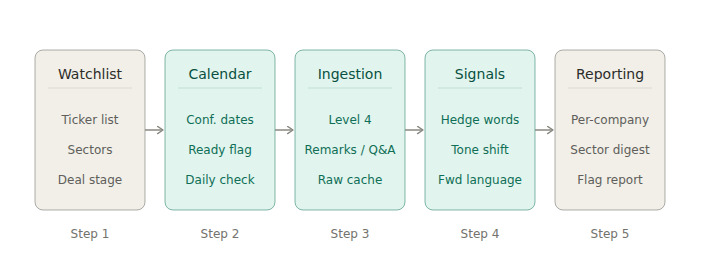
The portfolio monitoring API pipeline runs in five stages. The first is watchlist configuration: defining the company universe the system will track, organised by sector, deal stage, or coverage priority. The second is calendar polling: daily checks of the EarningsCall calendar endpoint for upcoming calls and transcript availability across the full watchlist. The third is transcript ingestion: automated retrieval the moment transcript_ready is confirmed for any watchlist company. The fourth is signal extraction: processing each transcript for the specific metrics relevant to the PE team's research framework. The fifth is the reporting layer: delivering structured output to the analysts who need it, in whatever format and channel they use.
Building each stage independently is worth the planning overhead. A modular architecture means the watchlist can be updated without rebuilding the ingestion logic, and the signal extraction layer can be refined without touching the calendar polling or delivery infrastructure.
from earningscall import get_company

company = get_company("aapl")
transcript = company.get_transcript(year=2026, quarter=1)
At level 4 access, the transcript object returns prepared remarks and Q&A as separate objects. For PE private equity financial data workflows, this separation matters because management-scripted language in prepared remarks carries different analytical weight than off-script responses under analyst questioning. A company reporting strong results in prepared remarks but becoming defensive around margin questions in Q&A is showing a pattern that warrants deeper investigation.
Scaling the Earnings Call Monitoring API Across the Full Universe
Scaling the earnings call monitoring API across a large comparable universe introduces two operational requirements that do not appear in smaller deployments.
The first is volume management during earnings season. The majority of large-cap and mid-cap public companies report within a three-week window after each quarter closes. During peak reporting weeks, a monitoring system covering two hundred companies may need to ingest and process fifty or more transcripts in a 48-hour period. The EarningsCall SDK's built-in retry configuration with exponential backoff handles rate limiting automatically, but the signal extraction and reporting layers also need to be designed for batch processing rather than sequential single-company workflows.
The second is output organisation across a large universe. Raw transcript access at scale is only useful if the output is structured in a way that allows analysts to triage intelligently. A flat list of two hundred transcripts available for review each quarter is not meaningfully better than a manually sourced list. The value of private equity financial data automation comes from the organisation layer on top of the raw transcript access.
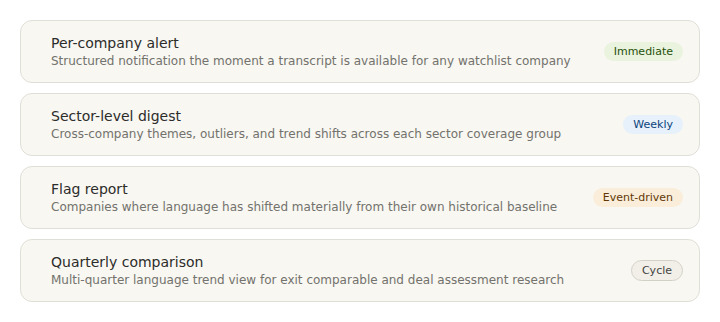
Three output structures cover most PE team needs. The first is a per-company alert: a structured notification delivered the moment a transcript is available for any watchlist company, containing a summary of key prepared remarks, guidance language, and any notable Q&A exchanges. The second is a sector-level digest: a weekly or cycle-level summary aggregating signals across all companies in a given sector coverage group, surfacing cross-company themes, outliers, and trend shifts. The third is a flag report: a targeted output identifying companies where the current quarter's language has shifted materially from their own historical pattern, warranting analyst attention regardless of whether the numerical results have changed.
For PE teams who want to extend the monitoring system with language-based risk signals, Using Earnings Call Transcripts to Reduce Portfolio Risk covers the NLP scoring layer that can be applied on top of the same transcript data to generate systematic risk flags across a coverage universe.
Organising Private Equity Financial Data by Investment Stage
A monitoring system that treats all watchlist companies identically misses an opportunity to match signal granularity to analytical need. PE teams can configure the pipeline to deliver different depth of output depending on where each company sits in the investment framework.
For companies at the deal screening stage, a lightweight alert containing guidance language, market commentary, and any mentions of M&A activity is typically sufficient. The goal is to surface relevant information without generating reading overhead for companies that have not yet cleared initial screening criteria.
For companies at the active monitoring stage, where the team is tracking a sector closely for deal development or portfolio benchmarking, a more detailed output is appropriate. This includes the full prepared remarks, highlighted Q&A exchanges relevant to the team's research thesis, and a comparison against the previous two quarters to surface language drift.
For companies at the exit comparable stage, where the team needs the most granular view of how public market peers are characterising valuation, synergy potential, and strategic priorities, a full transcript with speaker-level attribution at level 2 or level 4 access gives analysts the raw material to build detailed comparable analysis without leaving the monitoring system.
The Journal of Finance and related academic literature have documented that earnings call language carries information about future performance that is not fully reflected in same-period numerical disclosures. For PE teams whose investment thesis depends on identifying information gaps between current price and intrinsic value, systematic language monitoring provides a data layer that purely numerical monitoring cannot replicate.
For teams building CEO-specific language tracking as part of their management assessment process, How to Analyze CEO Language Patterns Over Time with EarningsCall API covers the longitudinal extraction and NLP pipeline that sits on top of the same infrastructure.
Production Considerations for PE Portfolio Monitoring
Three decisions shape the reliability of a PE portfolio monitoring system at scale.
The first is watchlist maintenance. Coverage universes change every quarter as companies are acquired, go private, or become newly public. A monitoring system that does not have a structured process for watchlist updates will gradually drift out of alignment with the actual research universe. Scheduling a quarterly watchlist audit alongside the earnings cycle keeps the system current.
The second is historical baseline storage. The most actionable signals in a portfolio monitoring API are not absolute scores but deviations from a company's own historical pattern. Storing rolling four-to-eight-quarter transcript data and derived signals for every watchlist company makes this relative comparison possible without rebuilding historical archives from scratch each time a new signal type is added.
The third is analyst workflow integration. A monitoring system that delivers output to a separate platform the team does not regularly use will not be used. Routing alerts to existing communication channels, whether email, Slack, or an internal research management system, removes the friction that causes well-designed systems to fall into disuse after the first earnings cycle.
FAQ
What is an earnings call monitoring API for private equity teams?
An earnings call monitoring API for private equity teams is a programmatic system that tracks a defined company universe across earnings events, retrieves transcripts automatically when they become available, and delivers structured output to analysts without manual sourcing or calendar management.
How many companies can a portfolio monitoring API track simultaneously?
The EarningsCall API covers 9,000+ public companies, so the portfolio monitoring API can track any size comparable universe within that coverage. The operational ceiling is set by the extraction and reporting infrastructure, not by the data provider's coverage.
What private equity financial data can be extracted from earnings call transcripts?
Earnings call transcripts provide management commentary on revenue trends, margin dynamics, competitive positioning, M&A activity, and forward guidance. At level 4 access, the EarningsCall API separates prepared remarks from Q&A, enabling PE teams to analyse scripted management communication separately from unscripted responses.
How does the monitoring system handle peak reporting volume during earnings season?
The EarningsCall SDK includes configurable retry logic with exponential backoff that handles rate limiting automatically during high-volume periods. The reporting layer should be designed for batch processing to manage the concentration of transcript availability during the two to three week peak reporting window after each quarter closes.
Does the system require a dedicated engineering team to maintain?
The core pipeline, calendar polling, transcript retrieval, and basic signal extraction, can be maintained by a single technically proficient analyst once the initial build is complete. More sophisticated extraction and reporting features may require dedicated engineering support, particularly if the output is integrated with existing research management or data systems.
Conclusion
An earnings call monitoring API transforms what is otherwise a manually intensive, seasonally concentrated research process into a continuous, systematic intelligence layer that scales across the full comparable universe a PE team needs to track. The portfolio monitoring API architecture described in this guide handles calendar management, transcript retrieval, and signal extraction automatically, delivering structured private equity financial data in a format that matches the team's existing research workflow.
The EarningsCall API provides the data foundation: 9,000+ company coverage, consistent transcript structure at multiple access levels, and a Python SDK designed for production pipeline integration. The intelligence layer on top of that foundation, how signals are extracted, organised, and delivered, is where the PE team's proprietary research framework is applied.
For full API documentation and SDK integration guides, visit the EarningsCall developer guide. For company filings and supplemental financial data, SEC EDGAR is the primary public resource.