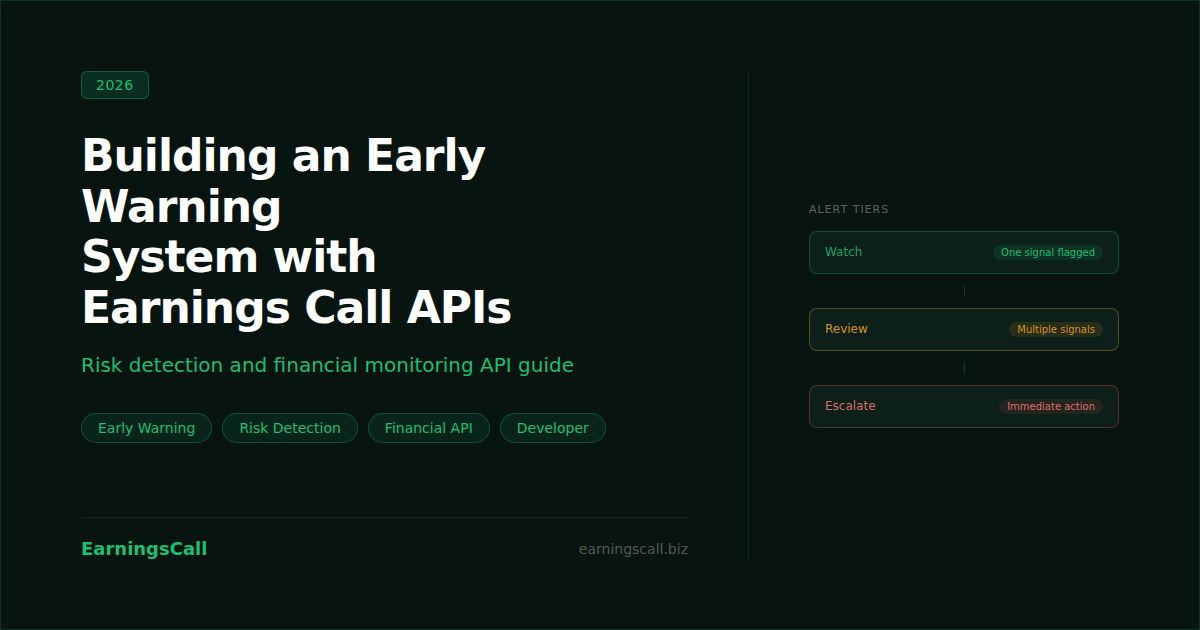
Build an Early Warning Risk Detection System with Earnings API
The gap between when a financial risk begins to form and when it becomes visible in price data or formal disclosures is where early warning systems earn their value. A company whose management team begins hedging its guidance language, avoiding specifics in analyst Q&A, and increasing references to execution uncertainty is signalling deteriorating conditions before any of that appears in a balance sheet or earnings revision.
Building a risk detection system on top of earnings call transcript data closes that gap. This guide walks through how developers can design and implement a financial monitoring API pipeline that moves beyond simple alert delivery into proactive deviation detection, multi-signal correlation, and tiered escalation. The result is a system that flags risk before it becomes visible, not after.
What an Early Warning System Does That an Alert System Does Not
An earnings call alert system notifies users when a transcript is available. That is useful but reactive. An early warning risk detection system goes further: it analyses the content of each transcript, compares it to the company's own historical baseline, correlates signals across multiple dimensions, and escalates only when the combined evidence crosses a threshold that warrants human attention.
The distinction matters architecturally. An alert system triggers on an event, transcript availability. An early warning system triggers on a deviation from expected behaviour. That shift from event-based to deviation-based triggering is what makes the system a genuine intelligence layer rather than a notification service.
Research published through the National Bureau of Economic Research has documented that earnings call language carries forward-looking information about firm outcomes that is not fully reflected in contemporaneous numerical disclosures. A financial monitoring API that converts that language signal into a tiered warning output gives decision-makers structured intelligence rather than raw data.
The Four Components of a Financial Monitoring API Early Warning System
A production early warning risk detection system built on earnings transcript data requires four independent, composable components.
The first is the signal layer. This extracts language-based risk signals from each transcript: hedge word density, guidance specificity, Q&A evasiveness, regulatory mention frequency, and CEO-to-CFO tone divergence. Each signal is computed from the raw transcript text at the per-section level, with prepared remarks and Q&A processed separately at level 4 access.
The second is the detection layer. This compares the current quarter's signal scores to the company's own rolling baseline across the previous four to eight quarters. The output is a set of deviation scores, not absolute risk scores. A company with a naturally cautious communication style will always score high in absolute hedge word frequency; what matters is whether this quarter's score deviates materially from its own historical pattern.
The third is the threshold engine. This applies configurable escalation rules to the deviation scores and determines which alert tier, if any, the current quarter's data warrants. Threshold design is a configuration decision, not a technical one: the system should make thresholds adjustable without code changes.
The fourth is the delivery layer. This routes the alert to the appropriate channel, email, Slack, webhook, or internal dashboard, with the escalation tier, the specific signals that triggered it, and the company's historical context included in the payload.
Building the Risk Detection System Architecture
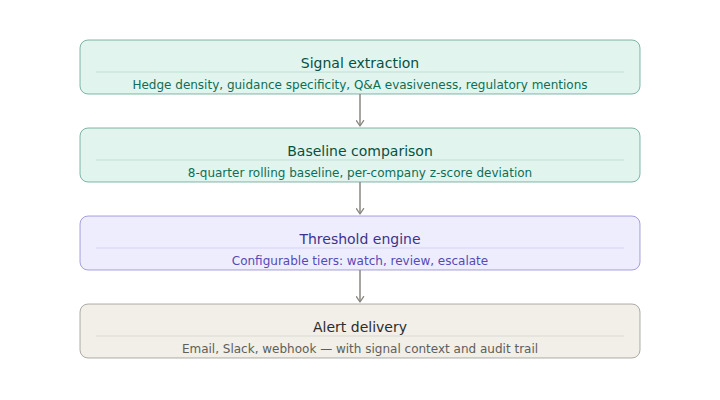
The EarningsCall financial monitoring API provides the data foundation. The calendar endpoint detects when transcripts become available. The Python SDK retrieves structured content at level 4, separating prepared remarks and Q&A for independent processing.
import earningscall
from earningscall import get_company, get_calendar
from datetime import date

earningscall.api_key = "YOUR-API-KEY"

calendar = get_calendar(date(2026, 5, 1))

company = get_company("jpm")
transcript = company.get_transcript(year=2026, quarter=1)

prepared = transcript.prepared_remarks
qa = transcript.questions_and_answers
The signal extraction step processes each section independently. Prepared remarks carry management's reviewed narrative and guidance language. Q&A carries the unscripted analyst exchanges where risk disclosures that management would prefer to minimise often surface under direct questioning. Giving the two sections different weights in the composite signal score produces a more accurate deviation detection than treating the full transcript as a single block.
The baseline comparison step requires per-company historical storage. A rolling eight-quarter window for each company in the coverage universe is sufficient for a stable baseline without over-indexing on conditions from several years prior. Storing raw signal scores alongside the transcript metadata for each quarter means the baseline can be recomputed if signal extraction logic is updated, without re-fetching transcript data from the API.
from earningscall import get_company

company = get_company("aapl")

historical_scores = []
for year in [2024, 2025, 2026]:
    for quarter in [1, 2, 3, 4]:
        transcript = company.get_transcript(year=year, quarter=quarter)
        if transcript:
            score = extract_signals(transcript)
            historical_scores.append(score)

baseline = compute_baseline(historical_scores)
current = extract_signals(company.get_transcript(year=2026, quarter=2))
deviation = compute_deviation(current, baseline)
For developers who want to explore how the alert delivery layer works separately from the risk signal architecture, Build an Earnings Call Alert System with EarningsCall API and Claude covers the notification infrastructure in detail.
Threshold Design in a Financial Monitoring API
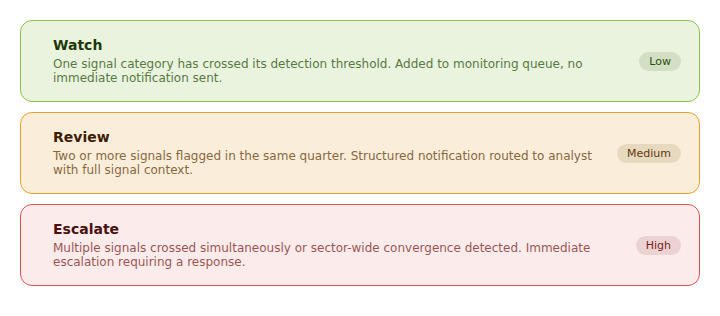
Threshold design is the most consequential configuration decision in any financial monitoring API early warning system. Set thresholds too low and the system generates too many false positives, eroding analyst trust until they stop acting on warnings. Set them too high and material risk signals are missed.
Three escalation tiers cover most risk monitoring use cases.
The first tier is a watch signal. One deviation score across any signal category has crossed the detection threshold. No action is required, but the company is added to the monitoring queue for additional scrutiny in the next reporting period. The watch tier produces a record in the system but does not route a notification to the analyst.
The second tier is a review signal. Two or more deviation scores have crossed their thresholds in the same quarter, or a single signal has crossed at a high confidence level. A structured notification is routed to the analyst with the specific signals that triggered it, the company's eight-quarter baseline, and the current quarter's deviation magnitude. The analyst decides whether to investigate further.
The third tier is an escalation signal. Multiple signals have crossed their thresholds simultaneously, or the same company has been in the watch tier for two consecutive quarters and has now crossed into review, or the company's deviation pattern is consistent with a cross-company sector signal that has also flagged. Escalation routes an immediate notification with a full signal report, tagged as requiring a response within a defined time window.
The Journal of Finance and affiliated academic literature on early warning systems in financial markets consistently find that the most effective systems calibrate thresholds on out-of-sample historical data rather than the same period used to build the signal model. Building a holdout calibration dataset from historical transcripts before setting production thresholds is worth the additional effort.
Cross-Company Pattern Detection as an Early Warning Input
The most distinctive capability of a risk detection system built at scale is the ability to detect cross-company convergence signals that are not visible when monitoring individual companies in isolation.
When five companies in the same sector all show elevated hedge word density in the same quarter, that pattern may indicate an emerging sector-level risk condition before any individual company has crossed its escalation threshold. The sector-level signal should feed into the threshold engine as an additional input: a company whose individual deviation scores are just below the review threshold but whose sector has flagged a convergence pattern warrants a watch signal regardless.
from earningscall import get_sp500_companies

sector_signals = {}
for company in get_sp500_companies():
    transcript = company.get_transcript(year=2026, quarter=1)
    if transcript:
        score = extract_signals(transcript)
        deviation = compute_deviation(score, get_baseline(company))
        sector_signals.setdefault(company.sector, []).append(deviation)

for sector, deviations in sector_signals.items():
    if sector_convergence_detected(deviations):
        trigger_sector_watch(sector)
This cross-company pattern detection layer is what separates a mature financial monitoring API early warning system from a collection of individual company monitors. It requires broader coverage than most individual company monitoring systems maintain, which is where the EarningsCall API's 9,000+ company universe and get_sp500_companies() function become relevant: sector-level pattern detection requires enough companies per sector to make the pattern statistically meaningful.
For developers building the sector-level monitoring architecture in depth, Earnings Transcript Monitoring for Regulatory Risk covers sector-level convergence detection and aggregated output design in a compliance monitoring context that applies equally to a general early warning system.
Production Considerations
Three operational decisions shape how reliably the system performs at scale.
The first is transcript ingestion ordering. During peak earnings weeks, dozens of transcripts may become available within hours of each other. The ingestion queue should prioritise by risk tier: companies in the watch tier or flagged in the previous quarter should be processed first, so the detection and threshold engine can update their status before less critical companies are processed.
The second is alert deduplication. When the same company triggers alerts across multiple signal categories in the same quarter, those alerts should be consolidated into a single structured notification rather than generating separate notifications per signal. An analyst receiving three separate alerts about the same company in the same hour will quickly learn to ignore the system.
The third is audit trail maintenance. Every threshold crossing, alert generation, and analyst action taken in response to an alert should be logged with timestamps. The audit trail serves two purposes: it enables retrospective calibration of threshold accuracy, and it provides the documentation that risk and compliance functions require for any system that informs investment or credit decisions.
For developers building a broader quantitative approach to transcript-based risk signals alongside the early warning architecture, Using Earnings Call Transcripts to Reduce Portfolio Risk: A Quant Approach covers the statistical signal design that feeds into the detection layer described in this guide.
FAQ
What is an early warning risk detection system for financial markets?
An early warning risk detection system monitors a defined company universe for language-based signals in earnings call transcripts that deviate materially from each company's own historical baseline. When deviations cross configured thresholds, the system escalates a structured warning to the appropriate analyst or risk team before the underlying risk becomes visible in price data or formal disclosures.
How is an early warning system different from an earnings alert system?
An earnings alert system triggers when a transcript becomes available. An early warning risk detection system triggers when the content of a transcript shows a meaningful deviation from expected behaviour. The former is event-based; the latter is deviation-based and requires a historical baseline, signal extraction logic, and configurable threshold rules.
What data does the EarningsCall financial monitoring API provide for early warning systems?
The EarningsCall API provides structured transcript data at multiple access levels, including separated prepared remarks and Q&A sections at level 4 access, speaker names and titles, a calendar endpoint with transcript availability status, and coverage of 9,000+ public companies through a Python SDK.
How should escalation thresholds be calibrated?
Thresholds should be calibrated on out-of-sample historical data, ideally using a holdout period from two to three years before the production start date. Calibration should optimise for a balance between true positive rate and false positive rate that the analyst team can operationally sustain. Starting conservatively and adjusting downward as the system proves reliable is safer than starting aggressively and losing analyst trust through excessive false alerts.
Can the system detect risk signals before they appear in formal SEC filings?
Academic research has documented that earnings call language often carries information about regulatory and financial risk conditions before those conditions appear in formal filings. The early warning system is designed to surface these signals as structured warnings, not as definitive risk assessments. Human judgment remains essential for evaluating whether a flagged signal warrants a material response.
Conclusion
A risk detection system built on the EarningsCall financial monitoring API goes beyond notification delivery into proactive deviation detection, tiered escalation, and cross-company pattern correlation. The four-component architecture — signal layer, detection layer, threshold engine, and delivery layer — provides the structural separation that makes the system maintainable and improvable without requiring a full rebuild each time signal extraction logic is updated or coverage is expanded.
The EarningsCall API provides the data foundation: calendar-based monitoring, level 4 transcript access, and 9,000+ company coverage through a consistent Python SDK. The early warning intelligence sits in the layers developers build on top of that foundation, calibrated to their specific coverage universe, risk appetite, and analyst workflow.
For full API documentation and SDK integration guides, visit the EarningsCall developer guide. For company filings and supplemental financial data, SEC EDGAR is the primary public resource.