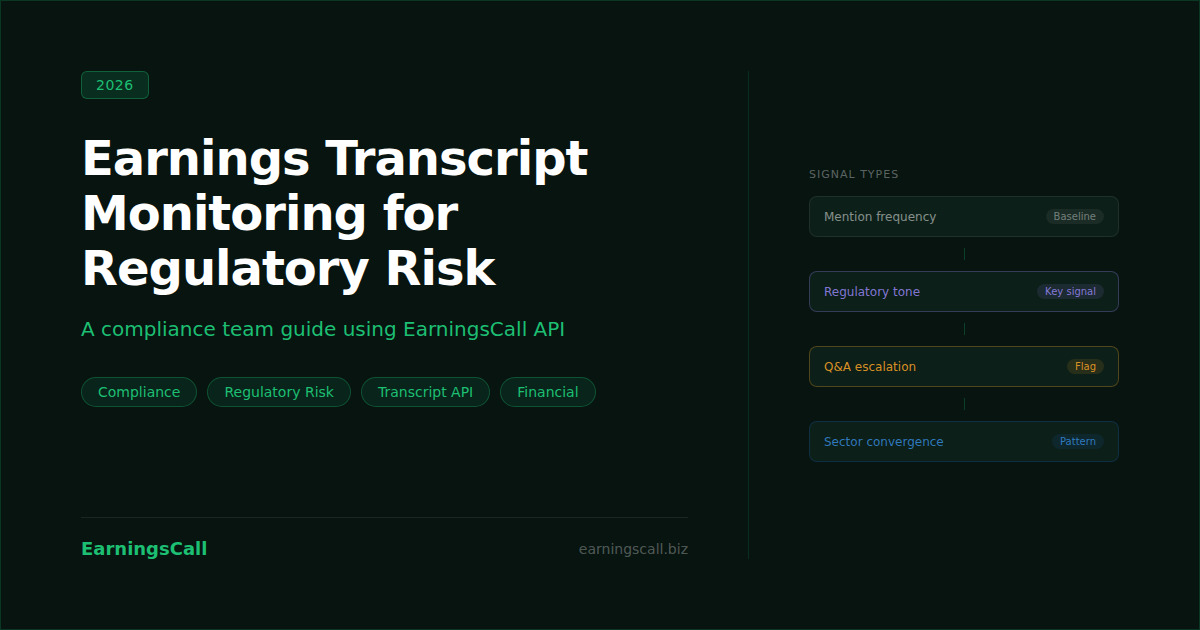
Earnings Transcript Monitoring for Regulatory Risk: A Compliance Team Guide
Earnings calls are among the most information-dense regulatory disclosures a public company produces each quarter. Management discusses pending investigations, regulatory responses, compliance program updates, consent orders, and legal proceedings in the prepared remarks and Q&A sections of every call. For a compliance team responsible for monitoring regulatory risk across a sector or a portfolio of holdings, that information is both highly relevant and structurally difficult to access at scale.
Earnings transcript compliance monitoring addresses this directly. A financial compliance API that provides programmatic transcript access enables systematic extraction of regulatory language signals across thousands of companies, turning a previously manual review process into an automated, auditable workflow. This guide walks through how compliance teams can build a regulatory risk monitoring system on the EarningsCall API that tracks regulatory disclosures, flags language shifts, and delivers structured reports across a full sector coverage universe.
Why Earnings Transcript Compliance Monitoring Matters
Public company management teams are legally required to disclose material regulatory risks and developments in their earnings communications. This makes earnings calls a structured, auditable source of regulatory intelligence that compliance teams can rely on as an official disclosure channel rather than an informal signal.
The practical challenge is volume. A compliance team covering a financial services sector may need to monitor forty or fifty companies per quarter. A broader coverage mandate across multiple sectors can involve hundreds of companies. Manual review of full transcripts at that volume is operationally unsustainable, and keyword searches on unstructured text miss the contextual language that distinguishes a routine compliance update from a material escalation.
Research published through the National Bureau of Economic Research has documented that corporate disclosures in earnings communications carry forward-looking regulatory risk information that does not always appear simultaneously in formal SEC filings. For a regulatory risk monitoring programme, this means earnings transcripts can surface material compliance signals in advance of the structured disclosures that appear in 10-Q and 10-K filings.
The CFA Institute's standards on material non-public information and compliance consistently identify earnings calls as a primary source of official management disclosure. Building a systematic earnings transcript compliance workflow on that source is consistent with established compliance practice, not a workaround.
What Regulatory Risk Monitoring Extracts from Earnings Calls
Before building a pipeline, it is worth defining the specific signal categories that a regulatory risk monitoring system should extract from earnings transcript data.
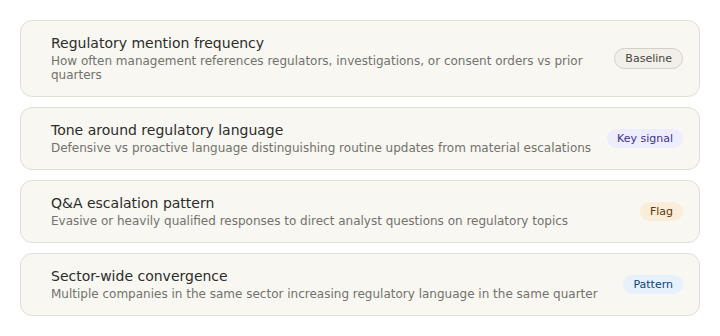
The first is regulatory mention frequency. How often does management reference regulators, investigations, consent orders, or compliance programmes in a given call, and how does that frequency compare to prior quarters and to sector peers? A company where regulatory mentions have doubled quarter over quarter warrants attention independent of whether the underlying issue is new.
The second is the tone surrounding regulatory language. Management can discuss a regulatory matter defensively or proactively. A defensive posture, characterised by hedging language, non-committal responses to analyst questions, and minimal detail, carries a different risk signal than a proactive posture where management volunteers information, quantifies exposure, and outlines a clear remediation timeline.
The third is Q&A escalation. When analysts press management specifically on regulatory topics and receive evasive or heavily qualified responses, that exchange pattern is a signal worth flagging. The Q&A section of an earnings call is the only moment where management faces unscripted questions, making it a structurally more revealing source for compliance intelligence than prepared remarks alone.
The fourth is sector-wide pattern detection. When multiple companies in the same sector begin increasing regulatory language simultaneously, that pattern may indicate an emerging sector-level regulatory development before any formal announcement is made. A financial compliance API pipeline that monitors a full sector universe can detect this kind of cross-company convergence systematically.
The Financial Compliance API Pipeline Architecture
The EarningsCall financial compliance API provides the data foundation for a compliance monitoring system. The Python SDK covers 9,000+ public companies and returns structured transcript data at multiple access levels, with the calendar endpoint enabling automated detection of upcoming calls and transcript availability.
import earningscall
from earningscall import get_company, get_calendar
from datetime import date

earningscall.api_key = "YOUR-API-KEY"

company = get_company("jpm")
transcript = company.get_transcript(year=2026, quarter=1)

calendar = get_calendar(date(2026, 5, 1))
At level 4 access, the transcript object separates prepared remarks from Q&A and includes speaker names and titles. For earnings transcript compliance monitoring, this structural separation is foundational. Regulatory language in prepared remarks reflects management's considered, reviewed communication about compliance matters. Regulatory language in Q&A reflects real-time responses under analyst questioning. The two sections carry different evidentiary weight in a compliance monitoring context and should be scored and stored independently.
from earningscall import get_company

company = get_company("gs")
transcript = company.get_transcript(year=2026, quarter=1)

prepared_text = transcript.prepared_remarks
qa_text = transcript.questions_and_answers
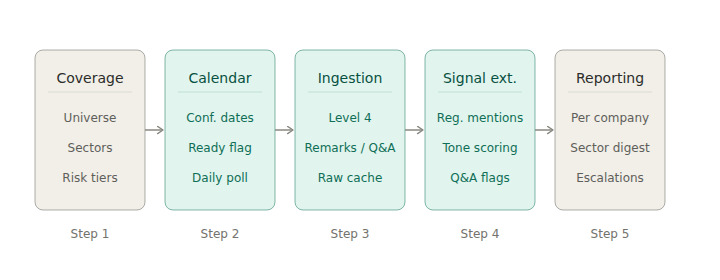
The pipeline architecture for a compliance monitoring system runs in five stages. The first is coverage configuration: defining the company universe the system will monitor, organised by sector, regulatory domain, or risk tier. The second is calendar polling: daily monitoring of the EarningsCall calendar for upcoming calls and transcript availability across the full coverage universe. The third is transcript ingestion: automated retrieval the moment transcript_ready is confirmed, with prepared remarks and Q&A stored separately. The fourth is signal extraction: processing each section against a regulatory language model to produce scored outputs. The fifth is compliance reporting: routing flagged signals to the appropriate review workflow.
For compliance teams already using transcript data for broader monitoring purposes, Earnings Call Data for Wealth Management: Improving Client Portfolio Reporting covers the watchlist architecture and tiered reporting logic that adapts directly to a compliance monitoring context.
Building the Earnings Transcript Compliance Signal Model
The signal extraction layer is where the earnings transcript compliance system produces its analytical output. A compliance-specific language model differs from a general-purpose sentiment or tone model in that it is calibrated for the specific vocabulary and contextual patterns relevant to regulatory risk.
A financial regulatory language model should cover at minimum four categories of signal. The first is explicit regulatory terminology: specific references to named regulators, regulatory processes, or enforcement actions. The second is compliance programme language: references to remediation plans, internal reviews, consent order fulfilment, or enhanced compliance controls. The third is hedging and uncertainty language specific to regulatory contexts: phrases like "subject to regulatory approval," "pending the outcome of," and "in cooperation with authorities." The fourth is materiality qualification language: specific phrases management uses to characterise the magnitude or expected impact of a regulatory matter.
Each of these categories can be scored with a dictionary-based approach that is transparent, auditable, and reproducible, which are essential properties for a compliance monitoring tool that may need to be explained to regulators or legal counsel. The Journal of Finance and affiliated working papers on textual analysis of regulatory disclosures provide a research basis for calibrating such dictionaries against observed outcomes.
Building a compliance-specific regulatory language dictionary from historical transcripts across the coverage universe is a two-to-four week project that produces a significantly more accurate signal than applying a general-purpose NLP model. The precision matters: a regulatory risk monitoring system that generates too many false positives will lose the trust of the compliance teams it is designed to support.
Sector-Level Regulatory Risk Monitoring
The most distinctive capability of a regulatory risk monitoring system built on a financial compliance API is sector-level signal detection. Individual company signals are valuable; cross-company convergence signals are often more actionable.
When multiple companies in the same sector begin increasing their regulatory mention frequency in the same quarter, that pattern may indicate several things. A new regulatory initiative has been signalled to industry participants informally before formal announcement. Enforcement activity in the sector has intensified and companies are disclosing their individual exposure. A sector-wide compliance deficiency has been identified by regulators and is manifesting across multiple institutions simultaneously.
Detecting this kind of cross-company convergence requires a coverage universe broad enough to represent the sector meaningfully. The EarningsCall API's coverage of 9,000+ companies, combined with the get_sp500_companies() function for major index coverage, provides the breadth needed for sector-level pattern detection.
from earningscall import get_sp500_companies

financial_sector = [
    c for c in get_sp500_companies()
    if c.sector == "Financials"
]
The sector-level digest produced by this approach gives compliance and legal teams a view they cannot obtain from monitoring individual companies in sequence. A single company's increasing regulatory language might be company-specific. The same pattern appearing across eight companies in the same sector in the same quarter is a sector-level signal that may require a different response.
For compliance teams building automated digest and summary capabilities alongside the monitoring system, How Financial News Platforms Can Automate Earnings Summaries with EarningsCall API covers the summarisation pipeline architecture that can be adapted to produce regulatory-focused digest outputs.
Reporting and Escalation in a Compliance Monitoring Workflow
A regulatory risk monitoring system is only as useful as its output structure. Signal extraction that delivers unstructured text dumps to a compliance inbox will not be used consistently. The reporting layer needs to match the way compliance teams actually triage and escalate issues.
Three output formats cover most compliance monitoring needs. The first is a per-company quarterly flag report: a structured document for each company in the coverage universe that summarises regulatory language metrics, compares them to prior quarters and sector peers, and flags any categories that have crossed escalation thresholds. The second is a sector-level digest: a periodic summary across all companies in each sector grouping, surfacing cross-company convergence signals and changes in sector-wide regulatory language patterns. The third is an escalation alert: an immediate notification when a specific company's regulatory language exceeds a defined threshold on any signal category, triggering a manual review step before the next routine reporting cycle.
The escalation threshold calibration is a compliance team decision, not a technical one. The system should make threshold configuration transparent and adjustable, so that the compliance function retains clear ownership of what triggers a review and what does not.
For earnings transcript compliance teams interested in how the same underlying data infrastructure supports broader financial intelligence applications, How to Build and Launch an Earnings Intelligence SaaS with EarningsCall API covers the multi-format output architecture that scales from a single compliance use case to a broader intelligence platform.
FAQ
What is earnings transcript compliance monitoring?
Earnings transcript compliance monitoring is the practice of systematically analysing earnings call transcripts for regulatory language signals, including mentions of investigations, enforcement actions, consent orders, and compliance programme updates. The goal is to detect material regulatory risk developments at scale across a sector or portfolio universe, before those developments are fully reflected in formal SEC filings or public announcements.
Why are earnings call transcripts a reliable source for regulatory risk signals?
Management teams are legally required to disclose material regulatory risks in their earnings communications. This makes earnings calls an official disclosure channel rather than an informal signal source. The Q&A section of an earnings call is particularly valuable because it captures unscripted management responses to direct analyst questions about regulatory matters.
How many companies can a financial compliance API monitor simultaneously?
The EarningsCall financial compliance API covers 9,000+ public companies. The practical ceiling for a compliance monitoring system is determined by the signal extraction and reporting infrastructure rather than by the data provider's coverage.
What programming languages does the EarningsCall API support?
EarningsCall provides a Python SDK and a JavaScript SDK with TypeScript support. Both support transcript retrieval, calendar access, and company lookup through the same underlying endpoints.
How should escalation thresholds be set for regulatory risk monitoring?
Escalation thresholds should be set by the compliance function based on their risk appetite, sector knowledge, and the operational capacity of the review team. The technical system should make thresholds configurable and auditable. Starting conservatively and adjusting based on false positive rates over the first two to three quarters of operation is the most practical calibration approach.
Conclusion
Earnings transcript compliance monitoring turns a previously manual, high-volume review process into a systematic, automated, and auditable workflow. A financial compliance API built on the EarningsCall platform provides the data foundation: 9,000+ company coverage, structured transcript access at multiple levels, and calendar-based detection of new transcript availability.
The regulatory risk monitoring system described in this guide addresses the four signal categories that matter most for compliance teams: regulatory mention frequency, tone around regulatory language, Q&A escalation patterns, and sector-wide convergence signals. Building the signal extraction and reporting layers on top of a clean, consistent data foundation means the compliance team spends its time on interpretation and escalation decisions rather than on transcript sourcing and manual review.
For full API documentation and SDK integration guides, visit the EarningsCall developer guide. For official company filings and regulatory disclosures, SEC EDGAR is the primary public resource.