Earnings Call Data for Wealth Management: Improving Client Portfolio Reporting
Client portfolio reporting in wealth management has a qualitative gap that numerical data alone cannot close. A quarterly report showing a portfolio's return, allocation breakdown, and benchmark comparison tells a client what happened to their wealth. It does not tell them what management teams at the companies in their portfolio said about the conditions that produced those results, or what they expect to happen next.
Wealth management earnings data from earnings call transcripts closes that gap. When a portfolio reporting API provides structured transcript access across a client's holdings, advisors can enrich quarterly reports with management commentary, forward guidance highlights, and sector-level language signals that give clients context for the numbers they are reading. This guide walks through how wealth management firms can integrate a financial data API into their reporting workflow to produce more informative, more defensible, and more differentiated client deliverables.
Why Earnings Call Data Matters for Wealth Management Reporting
Client portfolio reports are one of the primary touchpoints between a wealth manager and their clients. They are also one of the most undifferentiated deliverables in the industry. Most reports contain the same categories of information because they draw from the same numerical data sources: prices, returns, allocations, benchmarks.
The differentiation opportunity lies in the qualitative layer. What did the management teams of a client's holdings say last quarter? Where are they seeing cost pressure? Where are they confident about growth? What did analysts press them on in the Q&A? These questions have clear answers in earnings call transcripts, but sourcing those answers manually for every holding across every client relationship is operationally unsustainable at any meaningful scale.
Research published through the National Bureau of Economic Research has documented that earnings call language carries forward-looking information that complements numerical financial disclosures. For a wealth management firm whose value proposition includes active monitoring of client holdings, systematic access to that language through a portfolio reporting API translates directly into a more substantive client conversation.
What Wealth Management Earnings Data Actually Provides
Wealth management earnings data drawn from earnings call transcripts serves three distinct functions in a client reporting context.
The first is narrative context for quarterly results. When a portfolio holding reports disappointing revenue in a quarter where most sector peers also reported weakness, that context matters to the client's understanding of what happened. Management commentary from the earnings call provides exactly that context, in language that is far more accessible than a quantitative factor attribution.
The second is forward-looking signal. Earnings call guidance language is the most direct communication channel between a company's management team and its investors about what to expect in coming periods. For a wealth manager building client confidence in long-term positions, being able to show clients the specific guidance language management used, and how it compares to prior quarters, is a material improvement over presenting only backward-looking return data.
The third is risk signal. Language shifts in earnings calls, increasing hedge word density, more qualified guidance, defensive responses in Q&A, often precede the numerical deterioration that traditional risk models eventually detect. Incorporating wealth management earnings data as an early warning layer allows advisors to flag positions for closer review before a problem becomes visible in performance data.
The Financial Data API as Portfolio Reporting Foundation
The challenge for most wealth management firms is not access to individual earnings transcripts. It is structured, programmatic access to transcript data across a full client portfolio universe, updated consistently every quarter, without proportional increases in research staff time.
The EarningsCall financial data API provides this foundation. The Python SDK covers 9,000+ public companies and returns structured transcript content at multiple access levels. The calendar endpoint monitors upcoming earnings events for any watchlist of companies. The transcript_ready field confirms availability so the ingestion layer can trigger automatically rather than requiring manual checking.
import earningscall
from earningscall import get_company, get_calendar
from datetime import date

earningscall.api_key = "YOUR-API-KEY"

company = get_company("aapl")
transcript = company.get_transcript(year=2026, quarter=1)

calendar = get_calendar(date(2026, 5, 1))
At level 4 access, the transcript object separates prepared remarks from Q&A and includes speaker names and titles. For wealth management reporting, this separation is analytically important: prepared remarks contain the scripted management narrative and guidance that belongs in a client-facing summary, while Q&A contains the unscripted analyst exchanges that are more relevant for internal risk monitoring than for client communication.
For firms that have already built intelligence tooling on top of transcript data, How to Build and Launch an Earnings Intelligence SaaS with EarningsCall API covers the broader product architecture that a wealth management reporting workflow can draw from.
Building the Wealth Management Earnings Data Workflow
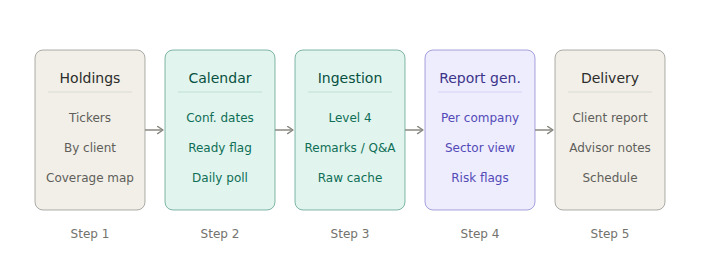
The portfolio reporting API workflow for wealth management runs in five stages. The first is holdings watchlist configuration: mapping each client's portfolio holdings to EarningsCall ticker symbols, grouped by client relationship. The second is calendar monitoring: daily polling of the calendar endpoint for any holdings across the full client base with upcoming calls or newly available transcripts. The third is transcript ingestion: automatic retrieval the moment transcript_ready is confirmed, with content stored by company and quarter. The fourth is report generation: processing transcript content into the structured format each report type requires. The fifth is client delivery: routing the generated content to the appropriate client report or advisor workflow.
Separating the ingestion and generation stages is worth the architectural overhead. Raw transcript data stored at ingestion can be processed into multiple report formats from a single source, and the report generation logic can be updated without re-fetching transcript data that is already cached.
from earningscall import get_company

company = get_company("msft")
transcript = company.get_transcript(year=2026, quarter=1)

prepared_summary = transcript.prepared_remarks
qa_highlights = transcript.questions_and_answers
The prepared remarks object feeds client-facing report sections where management narrative is appropriate. The Q&A object feeds internal advisor notes where the unscripted exchange with analysts is analytically relevant but may not be appropriate for direct client communication without editorial judgment applied.
Report Types That Benefit from Earnings Data
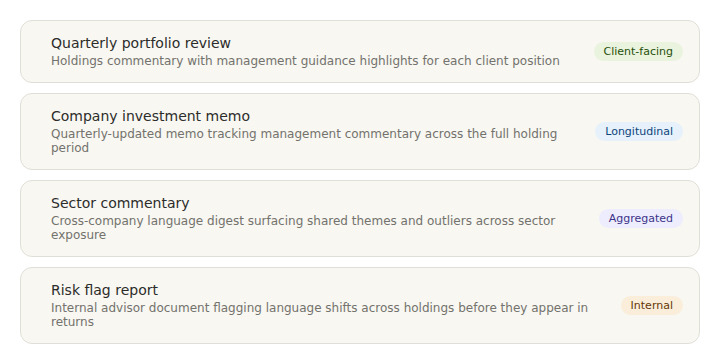
Four report types in wealth management are directly improved by wealth management earnings data from earnings call transcripts.
The first is the quarterly portfolio review. This is the primary client-facing deliverable most firms produce each quarter. Adding a holdings commentary section that summarises management guidance and key themes for each position elevates the report from a numerical summary to an analytical narrative. Clients who understand why their positions are held, in management's own words, are better positioned to maintain conviction through short-term volatility.
The second is the company investment memo. For concentrated positions or high-conviction holdings, a standing memo that is updated each quarter with the latest earnings call commentary provides a longitudinal record of management's execution against stated strategy. A financial data API that allows retrieval by company and quarter across multiple years makes this kind of historical comparison straightforward to build and maintain.
The third is sector commentary. Wealth management clients with meaningful sector exposure often want to understand how the sector is trending beyond their individual holdings. A sector digest that aggregates management language across the major companies in a sector, surfacing shared themes and outliers, is a differentiated deliverable that no purely numerical data source can produce. The EarningsCall portfolio reporting API covers 9,000+ companies, which means sector coverage is not limited to the largest names.
The fourth is the risk flag report. This is an internal document for the advisor rather than the client. It tracks language shifts across holdings, flagging companies where this quarter's management tone diverges materially from their own historical pattern. The Journal of Finance and related academic literature have documented that earnings call language often precedes numerical guidance revisions; a systematic risk flag process acts on that signal before it becomes visible in performance data.
For firms already building portfolio-level monitoring systems, Automating Earnings Call Monitoring Across Portfolio Companies covers the watchlist architecture and alert routing logic that applies equally to a wealth management reporting context.
Scaling the Portfolio Reporting API Across Client Relationships
A single advisor at a wealth management firm may serve fifty to a hundred client relationships. Across those relationships, portfolio holdings overlap significantly: large-cap equity holdings appear across many client portfolios simultaneously. A portfolio reporting API that is built at the holdings level rather than the client level captures this overlap efficiently.
Rather than running a separate transcript ingestion job for each client, the system maintains a single holdings universe covering every company held across all client relationships. When a transcript is ingested and processed for a company, the output is available to all client reports that include that holding. The client-level report assembly pulls from this central holdings store and combines the relevant company commentaries into the appropriate client report format.
This architecture means that marginal cost per client relationship decreases as the firm grows. Adding a new client whose holdings overlap substantially with existing portfolios requires no additional transcript ingestion; the content is already available.
The CFA Institute's research on client communication standards consistently highlights that advisor differentiation increasingly comes from the quality of insight and context provided alongside portfolio data, rather than from the data itself. A financial data API integration that systematically enriches client reports with earnings intelligence is a structural capability advantage rather than a one-time project.
For firms producing automated content summaries from transcript data as part of their client communication workflow, How Financial News Platforms Can Automate Earnings Summaries with EarningsCall API covers the summarisation pipeline architecture that can be adapted for internal wealth management use.
FAQ
What is wealth management earnings data?
Wealth management earnings data refers to earnings call transcript content, specifically management commentary, guidance language, and Q&A exchanges, that wealth management firms use to enrich client portfolio reporting and internal research. It provides qualitative context for the numerical data in standard portfolio reports and serves as an early warning layer for position-level risk monitoring.
How does a portfolio reporting API improve client reports?
A portfolio reporting API provides programmatic access to structured transcript data across a client's holdings, updated each quarter without manual sourcing. This allows wealth management firms to systematically include management commentary, forward guidance highlights, and sector-level language signals in client deliverables that previously contained only numerical return and allocation data.
How many companies does the EarningsCall financial data API cover?
The EarningsCall financial data API covers 9,000+ public companies through a Python SDK. Transcript data is available at multiple access levels, including separated prepared remarks and Q&A sections at level 4 access, and historical retrieval by year and quarter is supported through the same SDK interface.
Should earnings call commentary be included directly in client-facing reports?
The prepared remarks section of an earnings call, which contains scripted management narrative and forward guidance, is generally suitable for client-facing report sections. The Q&A section, which contains unscripted management responses to analyst questions, is typically more appropriate for internal advisor notes and risk monitoring, with editorial judgment applied before any client communication.
How does earnings call data fit alongside other portfolio reporting data?
Earnings call data complements rather than replaces numerical portfolio data. Return attribution, allocation data, and benchmark comparisons remain the primary numerical content of client reports. Earnings call commentary provides the qualitative narrative layer that explains what management teams said about the conditions that produced those results, and what they expect going forward.
Conclusion
Wealth management earnings data from earnings call transcripts closes the qualitative gap in client portfolio reporting that numerical data alone cannot address. A portfolio reporting API built on the EarningsCall financial data API gives wealth management firms programmatic access to management commentary, guidance language, and sector-level signals across their full holdings universe, updated automatically each quarter without proportional increases in research staff time.
The reporting architecture that works best treats transcript ingestion as a central holdings-level function, with client-level report assembly drawing from that shared source. The four report types that benefit most, quarterly portfolio reviews, investment memos, sector commentary, and risk flag reports, each use transcript data differently but draw from the same underlying pipeline. Building that pipeline once and serving multiple report formats from it is the most operationally efficient path for a wealth management firm looking to systematically improve the quality of what they put in front of clients each quarter.
For full API documentation and SDK integration guides, visit the EarningsCall developer guide. For company filings and supplemental financial data, SEC EDGAR is the primary public resource.