How Developers Use Earnings Call APIs for Financial Risk Analysis
Financial risk analysis has traditionally been a data problem. The numerical inputs, volatility measures, credit spreads, earnings surprise history, are well-covered by established data vendors. The gap is in the qualitative layer: what management teams actually say about liquidity, counterparty exposure, operational resilience, and regulatory pressure in their own words each quarter. For developers building risk tools, that qualitative layer has been difficult to access programmatically until earnings transcript APIs made structured text data available at scale.
Earnings call API risk analysis gives developers a new input class for risk models. This guide walks through how to integrate the EarningsCall financial risk analysis API into a developer workflow, which risk signal types earnings transcript data supports, and how to architect a pipeline that scales across a full coverage universe.
What Earnings Call API Risk Analysis Provides Developers
Before building a risk pipeline, it helps to understand why earnings call transcripts add analytical value that numerical data alone does not provide.
Numerical risk models are backward-looking by design. Volatility, beta, and factor exposures are all computed from historical price data. They measure risk that has already materialised. Earnings call transcripts carry forward-looking language from management teams with internal visibility into conditions that have not yet appeared in public financial data. A CEO discussing tightening credit conditions, a CFO flagging execution risk on a major integration, or a management team giving evasive answers to analyst questions about customer concentration all represent early-stage risk signals that numerical models cannot detect.
Research published through the National Bureau of Economic Research has documented systematic relationships between the linguistic content of earnings communications and subsequent firm outcomes, including credit events, guidance revisions, and return volatility. For developers building financial risk analysis API products, this research establishes the academic basis for treating earnings transcript language as a legitimate risk input alongside numerical data.
The EarningsCall API covers 9,000+ public companies through a Python SDK, returning structured transcript data at multiple access levels. At level 4, the transcript object separates prepared remarks from Q&A and includes speaker names and titles, which is the structural foundation that makes risk signal extraction reliable enough for production use.
Risk Signal Types in Earnings Call API Risk Analysis
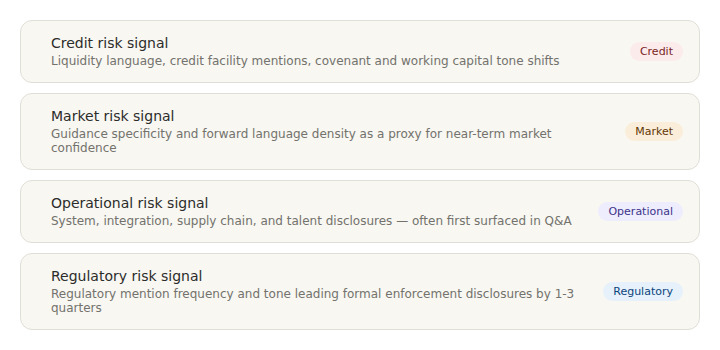
Earnings call API risk analysis supports four distinct risk signal types, each drawing on different parts of the transcript structure.
The first is credit risk signalling. Management language around liquidity, credit facility utilisation, debt covenant compliance, and working capital conditions often shifts materially before these issues appear in balance sheet data. Developers can build credit risk signals by scanning prepared remarks for specific language clusters and tracking their frequency and tone across consecutive quarters. A rising frequency of liquidity-related language, combined with increasingly hedged guidance on cash generation, is a composite signal worth surfacing in a credit monitoring tool.
The second is market risk signalling. Forward guidance language density and specificity is a measurable proxy for management confidence in near-term market conditions. A management team that shifts from specific numerical guidance to directional or conditional language is communicating uncertainty about market conditions even when the numbers they report remain acceptable. Tracking guidance language specificity across quarters gives developers a market risk signal that leads numerical data by one to two reporting periods.
The third is operational risk signalling. When management discusses system failures, integration challenges, talent retention issues, or supply chain disruptions in earnings calls, those disclosures are often the first public signal of operational risk that has been building internally. Q&A sections are particularly valuable here because unscripted analyst questions often surface operational issues that management prefers to minimise in prepared remarks.
The fourth is regulatory risk signalling, where earnings transcript language carries early signals of regulatory pressure before formal enforcement actions appear in SEC filings. The Journal of Finance and affiliated academic literature on textual analysis of regulatory disclosures have found that earnings call language often precedes formal regulatory announcements by one to three quarters.
For developers who want to go deeper on the regulatory risk dimension specifically, Earnings Transcript Monitoring for Regulatory Risk: A Compliance Team Guide covers the signal extraction architecture and compliance-specific language model design in detail.
Building a Financial Risk Analysis API Pipeline
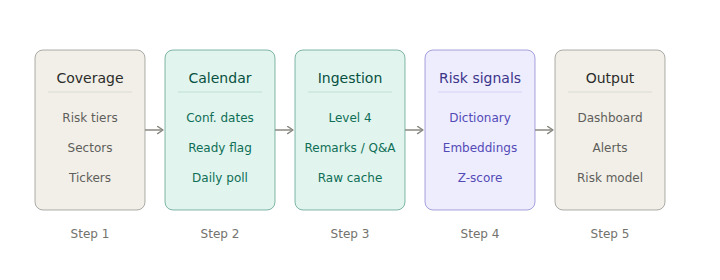
The financial risk analysis API pipeline for developers runs in five stages. Coverage configuration defines the company universe: which tickers to monitor, organised by risk tier, sector, or client relationship. Calendar monitoring polls the EarningsCall calendar endpoint daily for any coverage companies with upcoming calls or newly available transcripts. Transcript ingestion retrieves structured content the moment transcript_ready is confirmed. Risk signal extraction applies the language model to the ingested transcript text and produces scored outputs across each risk signal type. Risk output delivery routes the scores to whatever downstream system needs them, a risk dashboard, an alert system, a quantitative model, or a client report.
import earningscall
from earningscall import get_company, get_calendar
from datetime import date

earningscall.api_key = "YOUR-API-KEY"

company = get_company("jpm")
transcript = company.get_transcript(year=2026, quarter=1)

prepared = transcript.prepared_remarks
qa = transcript.questions_and_answers
Separating prepared remarks and Q&A at ingestion time is worth the architectural overhead. Risk signals extracted from prepared remarks reflect management's considered, reviewed communication about risk factors. Risk signals extracted from Q&A reflect real-time responses under analyst questioning. Treating the two sources as separate inputs, and weighting them differently in the composite risk score, produces more accurate and auditable output than processing the full transcript as a single block.
from earningscall import get_calendar
from datetime import date

calendar = get_calendar(date(2026, 5, 1))
The calendar endpoint returns the transcript_ready field for each scheduled company, enabling the ingestion stage to trigger automatically rather than running on a fixed schedule. During peak earnings reporting weeks, when fifty or more transcripts may become available in 48 hours, automated triggering on transcript_ready is significantly more reliable than a time-based batch job.
Risk Signal Extraction Architecture
The signal extraction layer is where earnings call API risk analysis translates raw transcript text into quantitative risk inputs. Three approaches are in common use among developer teams building this kind of system.
Dictionary-based scoring is the most transparent and auditable. A domain-specific vocabulary of risk-relevant terms and phrases is applied to the transcript text to produce frequency-based scores for each risk category. The vocabulary needs to be calibrated for financial language specifically: standard NLP libraries will undercount domain-specific risk signals like "subject to credit market conditions," "depending on revolver availability," and "execution risk on the integration." Building a custom financial risk vocabulary from historical transcripts across the coverage universe takes two to four weeks but produces significantly more accurate output than off-the-shelf solutions.
Embedding-based similarity analysis captures risk signals that dictionary methods miss, particularly when management uses novel phrasing to discuss familiar risk themes. By representing each transcript quarter as a dense vector and measuring similarity to a reference set of high-risk historical calls, a developer can detect elevated risk language even when it does not match any specific dictionary term. The tradeoff is interpretability: embedding-based signals are harder to explain to risk committees or regulators than dictionary-based scores.
Composite scoring combines both approaches. Dictionary scores cover the well-defined, auditable signal categories. Embedding similarity handles the open-vocabulary detection of novel risk language. The composite score is a weighted combination of both, with weights calibrated to the specific risk type and coverage universe.
The CFA Institute's research on investment risk frameworks consistently emphasises that transparency and auditability are essential properties of any risk model used in investment decision-making. For developers building tools that will be used by risk professionals or presented to regulators, a hybrid approach that can produce a clear explanation for any flagged signal is worth the additional complexity.
Scaling the Financial Risk Analysis API Across Coverage
For developers building risk products that serve multiple client relationships, the architecture decisions that shape the system at a few hundred companies also shape it at thousands. Three design choices have the most impact on how well the system scales.
The first is centralised transcript storage. Raw transcript objects retrieved from the EarningsCall API should be written to a shared data store immediately on retrieval, before any processing. Every downstream risk signal type reads from this store rather than making additional API calls. This eliminates redundant fetching, enables signal extraction logic to be updated and re-run without re-ingesting transcripts, and provides a complete historical archive that grows automatically each quarter.
The second is per-company baseline tracking. Absolute risk scores are less useful than risk scores relative to each company's own historical pattern. A company with a consistently cautious communication style will always score higher on hedge word density than one with a more confident style. What matters is the deviation from that company's own baseline, not the absolute score. Storing rolling eight-quarter baselines for each company in the coverage universe and computing z-scores rather than raw scores is the production-grade approach.
The third is rate handling during peak reporting periods. The EarningsCall SDK includes configurable retry logic with exponential backoff that handles rate limiting automatically. Configuring this explicitly before a heavy batch run prevents silent failures during the concentrated transcript availability window at the start of each reporting season.
import earningscall
from earningscall import get_sp500_companies

earningscall.api_key = "YOUR-API-KEY"

for company in get_sp500_companies():
    transcript = company.get_transcript(year=2026, quarter=1)
    if transcript:
        prepared = transcript.prepared_remarks
        qa = transcript.questions_and_answers
For developers who want to go deeper on quantitative approaches to transcript-based risk signals, Using Earnings Call Transcripts to Reduce Portfolio Risk: A Quant Approach covers the statistical signal design and baseline comparison methodology in detail.
For developers building their first EarningsCall integration before adding the risk signal layer, Building Financial Intelligence Tools with Earnings Call Data covers the foundational pipeline architecture.
FAQ
What is earnings call API risk analysis?
Earnings call API risk analysis is the practice of programmatically extracting risk signals from earnings call transcripts using an API, and incorporating those signals into financial risk models or monitoring systems. It supplements numerical risk inputs with qualitative language signals that often lead numerical data by one to three reporting periods.
What risk types can developers build with earnings transcript data?
Earnings transcript data supports credit risk signalling, market risk signalling, operational risk signalling, and regulatory risk signalling. Each risk type draws on different parts of the transcript structure: prepared remarks for management's reviewed narrative and guidance, and Q&A for unscripted analyst-management exchanges that surface issues management may not volunteer.
How does the EarningsCall financial risk analysis API structure transcript data?
At level 4 access, the EarningsCall API returns transcripts as structured objects with prepared remarks and Q&A sections as separate components, each with speaker names and titles. This structure is the foundation for risk signal extraction because it allows developers to treat scripted and unscripted management language as distinct inputs with different analytical weights.
How many companies can a financial risk analysis API pipeline cover?
The EarningsCall API covers 9,000+ public companies. The get_sp500_companies() function provides an S&P 500 starting point. Coverage beyond the S&P 500 is accessible by ticker symbol for any company in the full universe.
What is the difference between dictionary-based and embedding-based risk signal extraction?
Dictionary-based extraction counts the frequency of domain-specific risk terms and phrases. It is transparent and auditable but may miss novel risk language. Embedding-based extraction computes vector similarity between a current transcript and a reference set of high-risk historical calls. It detects open-vocabulary risk signals but is harder to explain. Production risk tools typically combine both approaches.
Conclusion
Earnings call API risk analysis gives developers access to a qualitative risk input class that numerical models structurally cannot provide. The EarningsCall financial risk analysis API delivers structured transcript data across 9,000+ companies, enabling risk signal extraction across credit, market, operational, and regulatory dimensions from the same underlying data pipeline.
The architecture pattern that works best in production treats transcript ingestion as a centralised function, signal extraction as a separate and independently updatable layer, and output routing as the component that adapts to whatever downstream risk system the developer needs to serve. This separation keeps the system maintainable as signal extraction methods improve and coverage universes expand.
For full API documentation and SDK integration guides, visit the EarningsCall developer guide. For company filings and supplemental financial data, SEC EDGAR is the primary public resource.