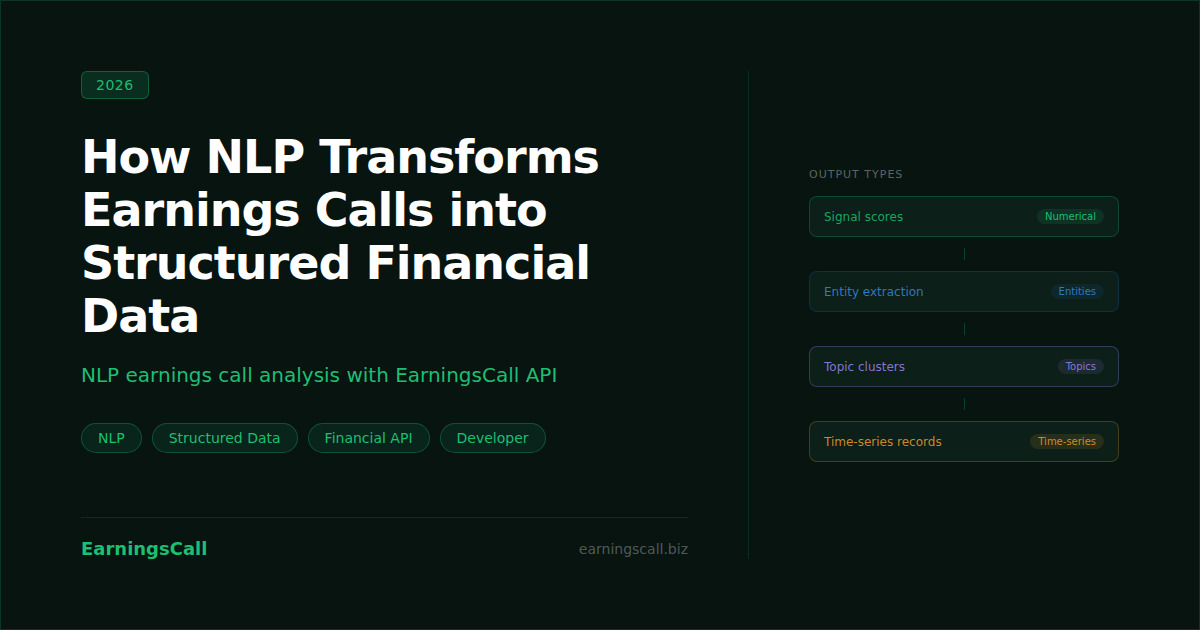
How NLP Transforms Earnings Calls into Structured Financial Data
An earnings call transcript starts as a wall of text. Tens of thousands of words, across two sections, from multiple speakers, covering financial results, operational updates, forward guidance, and unscripted analyst exchanges. For a developer or analyst reading a single transcript, the structure is intuitive. For a pipeline processing thousands of transcripts per quarter, raw text is unworkable without a transformation layer that converts language into structured, queryable data.
NLP earnings call analysis is that transformation layer. It takes the raw transcript text provided by a structured financial data API and produces numerical signals, entity lists, topic classifications, and time-series ready outputs that downstream applications can consume programmatically. This guide explains how that transformation works, what the pipeline looks like at each stage, and how the EarningsCall API's data structure reduces the preprocessing work that NLP pipelines typically require.
What Raw Transcript Text Looks Like Before NLP
Before understanding what NLP does, it helps to understand what it starts from. A raw earnings call transcript is a sequential record of speech, attributed to speakers, with no inherent structure beyond the order in which statements were made.
A prepared remark from a CFO discussing revenue might read: "We delivered net revenue of thirty-two point four billion dollars in the quarter, representing growth of eleven percent year over year, driven primarily by strength in our enterprise segment, though we do note that macroeconomic conditions in certain international markets remained challenging throughout the period."
That single sentence contains a revenue figure, a growth rate, a segment attribution, a hedging qualifier, and a geographic risk signal. A human analyst reading it extracts all five data points instinctively. An application trying to query "what revenue figure did this CFO report" or "which segments were cited as growth drivers" cannot do so from raw text without a structured representation of what the sentence contains.
NLP earnings call analysis produces that structured representation systematically across every sentence in every transcript.
How the Structured Financial Data API Reduces NLP Preprocessing
Raw transcript text from most sources requires significant preprocessing before NLP can be applied reliably. Speaker identification, section boundaries, and sequential ordering all need to be resolved before any linguistic analysis can begin. This preprocessing work is often more time-consuming than the NLP itself.
The EarningsCall structured financial data API eliminates most of this preprocessing by returning transcripts that are already structured at the data layer before any NLP is applied. At level 2 access, each statement in the transcript is attributed to a named speaker with their title. At level 4 access, the transcript is returned as two distinct objects, prepared_remarks and questions_and_answers, each containing speaker-attributed statements in sequence.
import earningscall
from earningscall import get_company
 earningscall.api_key = "YOUR-API-KEY"
 company = get_company("aapl")
transcript = company.get_transcript(year=2026, quarter=1)
 prepared = transcript.prepared_remarks
qa = transcript.questions_and_answers
This pre-structuring means an NLP earnings call analysis pipeline can begin linguistic processing immediately, without spending development time on speaker deanonymisation, section boundary detection, or sequential ordering. The sections are already separated. The speakers are already identified. The developer's NLP effort goes directly into signal extraction rather than data cleaning.
Research published through the National Bureau of Economic Research has documented that the structural distinction between scripted and unscripted speech in earnings calls carries meaningful analytical signal. The prepared remarks and Q&A sections are not interchangeable data sources: treating them as separate inputs from the start, which the EarningsCall API's level 4 structure enables, produces more accurate NLP output than processing the full transcript as a single block.
The NLP Earnings Call Analysis Pipeline
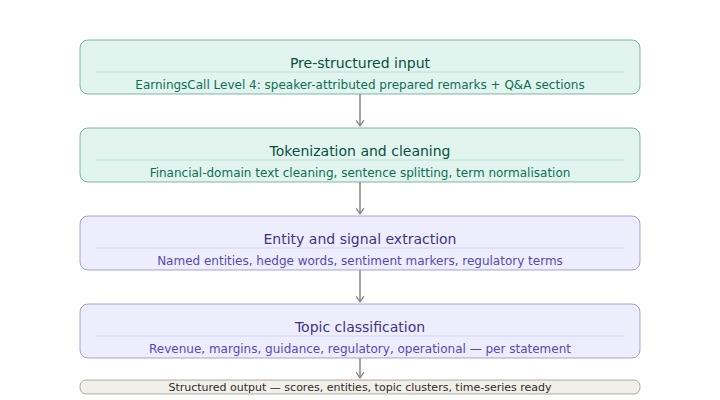
The transformation from raw transcript text to structured financial data moves through five stages. Each stage produces an intermediate representation that the next stage consumes.
Stage one: pre-structured input. The EarningsCall API returns the transcript as speaker-attributed statements in two sections. The input to the NLP pipeline is already organised by speaker role and section type, which allows every subsequent stage to apply section-specific logic rather than generic full-document processing.
Stage two: tokenization and text cleaning. Each statement is tokenised into sentences and words, with financial-domain cleaning applied. Standard NLP cleaning pipelines strip punctuation, normalise case, and remove stopwords, but financial text requires domain-specific handling: dollar figures, percentage expressions, quarter references, and company names all need to be preserved rather than normalised away.
import earningscall
from earningscall import get_company
 company = get_company("msft")
transcript = company.get_transcript(year=2026, quarter=1)
 for statement in transcript.prepared_remarks:
    speaker_title = statement.speaker_info.title
    text = statement.text
    tokens = tokenize_financial(text)
Stage three: entity and signal extraction. Named entity recognition identifies companies, regulators, geographic regions, and individuals mentioned in the transcript. Signal extraction applies domain-specific dictionaries to identify hedge words, forward-looking language markers, regulatory terminology, and numerical guidance expressions. Each identified signal is tagged with its sentence position, speaker identity, and section source.
Stage four: topic classification. Statements are classified into topic clusters relevant to financial analysis: revenue and growth commentary, cost and margin discussion, forward guidance, competitive positioning, regulatory and legal matters, and operational updates. Topic classification allows downstream applications to query "what did management say about margins" without reading the full transcript.
Stage five: structured output. The pipeline produces a structured object for each transcript containing numerical signal scores, entity lists with mention frequencies, topic-classified statement clusters, and metadata linking every output element back to its source statement, speaker, and section. This output is the queryable, time-series ready representation that downstream applications consume.
Output Formats in Structured Financial Data API Pipelines
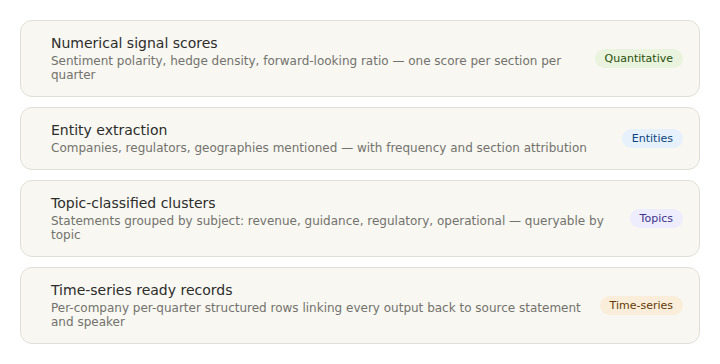
The structured output of an NLP earnings call analysis pipeline takes several forms depending on what downstream applications need.
Numerical signal scores are the most common output format for quantitative applications. Each signal category, hedge word density, forward-looking language ratio, sentiment polarity, guidance specificity, produces a numerical score for the transcript as a whole and for each section independently. These scores are stored as time-series data, one row per company per quarter, and queried the same way as any other numerical financial metric.
Entity extraction outputs list every company, person, regulator, and geographic region mentioned in the transcript with their mention frequency and the sections in which they appear. For competitive intelligence applications, the entity list surfaces competitor mentions that management may embed in prepared remarks or concede under analyst questioning. For regulatory monitoring applications, the entity list flags specific regulator mentions before formal disclosure events.
Topic-classified statement clusters group every statement in the transcript by subject area. A financial research application can query the guidance topic cluster directly rather than reading the full transcript to find what management said about the next quarter. A risk monitoring application can query the regulatory topic cluster across a hundred companies simultaneously to detect sector-level pattern shifts.
For developers building on top of structured earnings data, Performing Sentiment Analysis Using Earnings Call Data covers how sentiment scores derived from this transformation are applied in practice.
Dictionary-Based Versus Embedding-Based NLP Approaches
The signal extraction stage of an NLP earnings call analysis pipeline can be implemented with two fundamentally different approaches, and the choice has significant implications for accuracy, interpretability, and maintenance cost.
Dictionary-based approaches apply predefined word lists to the transcript text. A hedge word dictionary counts qualifying phrases like "subject to," "depending on," and "we believe." A forward-looking language dictionary counts tense markers and temporal references. Dictionary approaches are fast, transparent, and auditable: every signal score can be traced back to specific words in specific sentences. The limitation is coverage: a company using novel phrasing to discuss familiar risk themes may not match any dictionary entry.
Embedding-based approaches represent each statement as a dense numerical vector and measure similarity to reference statements with known properties. A statement semantically similar to a set of high-risk historical disclosures receives a high risk score regardless of whether it matches any specific dictionary entry. Embedding approaches capture novel language patterns but produce scores that are harder to explain to non-technical stakeholders.
The Journal of Finance and affiliated academic literature on textual analysis of financial disclosures consistently find that dictionary-based approaches, when calibrated specifically for financial language rather than applied from general-purpose NLP libraries, produce competitive accuracy with significantly lower complexity. For most structured financial data API pipelines in production, a well-calibrated financial domain dictionary is the appropriate starting point, with embedding-based approaches added for specific signal categories where dictionary coverage is insufficient.
For developers building the full financial intelligence stack on top of structured transcript data, Building Financial Intelligence Tools with Earnings Call Data covers the broader pipeline architecture from data ingestion through to application delivery.
Maintaining NLP Signal Quality Over Time
An NLP earnings call analysis pipeline requires ongoing maintenance that is distinct from the data infrastructure maintenance a structured financial data API integration requires.
The data infrastructure maintenance is handled by the API provider: EarningsCall maintains transcript coverage, speaker identification accuracy, and section boundary detection across 9,000+ companies. These are stable because they are based on the structural properties of the call format rather than linguistic content.
The NLP signal quality maintenance is the developer's responsibility. Management language evolves: phrases that reliably signal hedging in one market environment may become routine disclosure language in another. Dictionary coverage needs periodic review against new transcripts to identify emerging patterns that existing entries do not capture. Embedding models trained on historical transcripts may underweight novel risk language that has become more common in recent periods.
Building a quarterly signal quality review into the pipeline maintenance schedule, using a held-out set of manually labelled transcripts as a benchmark, is the most practical approach to maintaining accuracy without continuous re-engineering of the extraction logic.
For developers extending structured transcript data into risk monitoring applications, How Developers Use Earnings Call APIs for Financial Risk Analysis covers how the structured output described in this guide feeds into production risk signal pipelines.
FAQ
What is NLP earnings call analysis?
NLP earnings call analysis is the process of applying natural language processing techniques to earnings call transcript text to produce structured, queryable financial data. It transforms raw speech records into numerical signal scores, entity lists, topic classifications, and time-series ready outputs that applications can consume programmatically.
How does the EarningsCall API reduce NLP preprocessing work?
The EarningsCall API returns transcripts pre-structured at the data layer: speaker names and titles at level 2 access, and separated prepared remarks and Q&A sections at level 4 access. This eliminates the speaker deanonymisation, section boundary detection, and sequential ordering work that NLP pipelines typically require before linguistic analysis can begin.
What is the difference between dictionary-based and embedding-based NLP for earnings call analysis?
Dictionary-based NLP applies predefined word lists to count specific signal types. It is fast, transparent, and auditable but may miss novel language patterns. Embedding-based NLP represents text as numerical vectors and measures semantic similarity to reference examples. It captures novel language but is harder to explain. Most production pipelines use dictionary-based approaches for defined signal categories and embedding-based approaches where dictionary coverage is insufficient.
What structured data formats does an NLP earnings call pipeline produce?
A typical pipeline produces numerical signal scores for sentiment, hedging, and guidance specificity; entity extraction lists for companies, regulators, and geographies mentioned; topic-classified statement clusters organised by subject area; and time-series ready records linking every output element to its source statement, speaker, and section.
How many companies can the EarningsCall structured financial data API cover?
The EarningsCall API covers 9,000+ public companies through a Python SDK and JavaScript SDK with TypeScript support. Transcript data is available at multiple access levels and supports historical retrieval by year and quarter through the same interface as current-period calls.
Conclusion
NLP earnings call analysis converts raw transcript text into structured, queryable financial signals that applications can consume without reading a single transcript manually. The transformation pipeline moves through pre-structured input, tokenization, entity and signal extraction, topic classification, and structured output, with each stage producing a cleaner, more queryable representation of what management said and how they said it.
The EarningsCall structured financial data API reduces the preprocessing work this pipeline typically requires by returning transcripts already organised by speaker and section at the data layer. The NLP work starts at linguistic analysis rather than data cleaning, and the structured output feeds directly into the risk monitoring, sentiment analysis, and research automation applications that make earnings transcript data commercially useful at scale.
For full API documentation and SDK integration guides, visit the EarningsCall developer guide. For company filings and supplemental financial data, SEC EDGAR is the primary public resource.